Ch. 8 - Integration Techniques
Briggs - Calculus: Early Transcendentals 3rd Edition
Briggs3rd EditionCalculus: Early TranscendentalsISBN: 9780136847243Non è quello che usi tu?Cambia libro di testo
Capitolo 8, Problema 8.4.42

7-56. Trigonometric substitutions Evaluate the following integrals using trigonometric substitution.
42. ∫ 1/(x²√(9x² - 1)) dx, x > 1/3

Guida verificata passo dopo passo
1
Step 1: Recognize that the integral involves a square root of a quadratic expression, √(9x² - 1). This suggests using a trigonometric substitution to simplify the square root. Specifically, let x = (1/3)sec(θ), which transforms the quadratic expression into a form involving sec²(θ).
Step 2: Substitute x = (1/3)sec(θ) into the integral. Compute dx by differentiating x = (1/3)sec(θ), which gives dx = (1/3)sec(θ)tan(θ)dθ. Replace x and dx in the integral.
Step 3: Simplify the square root √(9x² - 1) using the substitution x = (1/3)sec(θ). Substituting x² = (1/9)sec²(θ) into 9x² - 1 gives √(9x² - 1) = √(sec²(θ) - 1) = tan(θ). Replace √(9x² - 1) with tan(θ) in the integral.
Step 4: After substitution, the integral becomes ∫(1/(x²√(9x² - 1)))dx = ∫(1/((1/9)sec²(θ) * tan(θ))) * (1/3)sec(θ)tan(θ)dθ. Simplify the expression by canceling terms and combining factors.
Step 5: The integral simplifies to ∫cos²(θ)dθ after substitution and simplification. Use a trigonometric identity, such as cos²(θ) = (1 + cos(2θ))/2, to rewrite the integral in a solvable form. Proceed to integrate and back-substitute θ using the original substitution x = (1/3)sec(θ).

Risposta video verificata per un problema simile:

Questa soluzione video è stata consigliata dai nostri tutor come utile per risolvere questo problema.
Durata del video:
5m

Concetti chiave

Ecco i concetti essenziali che devi comprendere per rispondere correttamente alla domanda.

Trigonometric Substitution

Trigonometric substitution is a technique used in calculus to simplify integrals involving square roots of quadratic expressions. By substituting a variable with a trigonometric function, such as sine or tangent, the integral can often be transformed into a more manageable form. This method is particularly useful for integrals that contain expressions like √(a² - x²), √(x² - a²), or √(x² + a²).
Video consigliato:
Percorso guidato
6:04
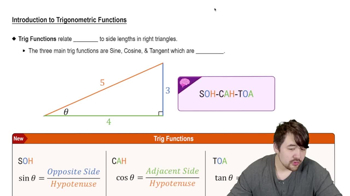
Introduction to Trigonometric Functions

Integration Techniques

Integration techniques encompass various methods used to evaluate integrals, including substitution, integration by parts, and partial fractions. Understanding these techniques is essential for solving complex integrals, as they provide strategies to break down the integral into simpler parts. Mastery of these methods allows for greater flexibility and efficiency in solving a wide range of integral problems.
Video consigliato:
Percorso guidato
06:18
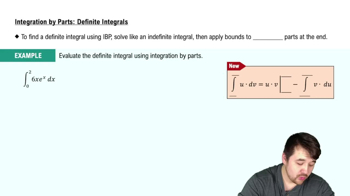
Integration by Parts for Definite Integrals

Definite vs. Indefinite Integrals

Definite integrals calculate the area under a curve between two specified limits, while indefinite integrals represent a family of functions without specific bounds. In the context of trigonometric substitution, recognizing whether an integral is definite or indefinite influences the approach taken, particularly in applying limits after substitution. This distinction is crucial for correctly interpreting the results of the integration process.
Video consigliato:
Percorso guidato
05:43
Definition of the Definite Integral