Ch. 8 - Integration Techniques
Briggs - Calculus: Early Transcendentals 3rd Edition
Briggs3rd EditionCalculus: Early TranscendentalsISBN: 9780136847243Non è quello che usi tu?Cambia libro di testo
Capitolo 8, Problema 8.9.13

7–58. Improper integrals Evaluate the following integrals or state that they diverge.
13. ∫ (from 0 to ∞) cos x dx

Guida verificata passo dopo passo
1
Recognize that the integral \( \int_0^{\infty} \cos x \, dx \) is an improper integral because the upper limit of integration is infinite.
Rewrite the integral as a limit: \( \lim_{t \to \infty} \int_0^t \cos x \, dx \). This allows us to evaluate the integral over a finite interval first and then analyze the behavior as \( t \) approaches infinity.
Find the antiderivative of \( \cos x \), which is \( \sin x \). So, \( \int_0^t \cos x \, dx = \sin t - \sin 0 = \sin t \).
Evaluate the limit \( \lim_{t \to \infty} \sin t \). Since \( \sin t \) oscillates between -1 and 1 and does not approach a single value, this limit does not exist.
Conclude that because the limit does not exist, the improper integral \( \int_0^{\infty} \cos x \, dx \) diverges.

Risposta video verificata per un problema simile:

Questa soluzione video è stata consigliata dai nostri tutor come utile per risolvere questo problema.
Durata del video:
3m

Concetti chiave

Ecco i concetti essenziali che devi comprendere per rispondere correttamente alla domanda.

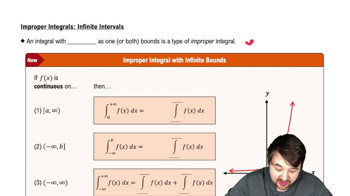
Improper Integrals

Improper integrals involve integration over an infinite interval or integrands with infinite discontinuities. To evaluate them, limits are used to define the integral as a limit of definite integrals over finite intervals. Determining convergence or divergence is essential.
Video consigliato:
Percorso guidato
11:11
Improper Integrals: Infinite Intervals

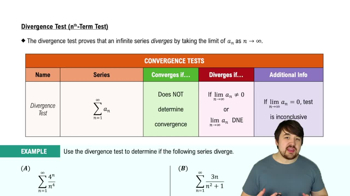
Convergence and Divergence of Integrals

An integral converges if its limit exists and is finite; otherwise, it diverges. For improper integrals over infinite intervals, convergence depends on the behavior of the integrand as the variable approaches infinity. Testing convergence often involves comparison or limit tests.
Video consigliato:
Percorso guidato
05:44
Divergence Test (nth Term Test)

Behavior of Oscillatory Functions in Integrals

Functions like cosine oscillate indefinitely without settling to a limit. When integrated over infinite intervals, their oscillations can cause the integral to fail to converge. Understanding how oscillatory behavior affects the integral's limit is crucial for evaluating such integrals.
Video consigliato:
05:11
Integrals of General Exponential Functions