Ch. 8 - Integration Techniques
Briggs - Calculus: Early Transcendentals 3rd Edition
Briggs3rd EditionCalculus: Early TranscendentalsISBN: 9780136847243Non è quello che usi tu?Cambia libro di testo
Capitolo 8, Problema 8.9.36

7–58. Improper integrals Evaluate the following integrals or state that they diverge.
36. ∫ (from e² to ∞) 1/(x lnᵖ x) dx, p > 1

Guida verificata passo dopo passo
1
Identify the integral to evaluate: \(\displaystyle \int_{e^{2}}^{\infty} \frac{1}{x (\ln x)^{p}} \, dx\) where \(p > 1\).
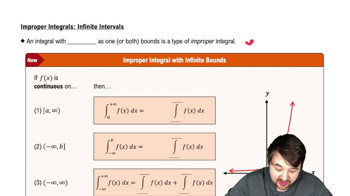
Recognize that this is an improper integral because the upper limit of integration is infinite. We rewrite it as a limit: \(\displaystyle \lim_{t \to \infty} \int_{e^{2}}^{t} \frac{1}{x (\ln x)^{p}} \, dx\).
Use the substitution \(u = \ln x\), which implies \(du = \frac{1}{x} dx\). This transforms the integral into \(\displaystyle \lim_{t \to \infty} \int_{\ln e^{2}}^{\ln t} \frac{1}{u^{p}} \, du\).
Simplify the limits of integration: since \(\ln e^{2} = 2\), the integral becomes \(\displaystyle \lim_{t \to \infty} \int_{2}^{\ln t} u^{-p} \, du\).
Evaluate the integral \(\int u^{-p} \, du\) for \(p \neq 1\), which is \(\frac{u^{-p+1}}{-p+1} + C\). Then apply the limits from 2 to \(\ln t\) and analyze the limit as \(t \to \infty\) to determine if the integral converges or diverges.

Risposta video verificata per un problema simile:

Questa soluzione video è stata consigliata dai nostri tutor come utile per risolvere questo problema.
Durata del video:
6m

Concetti chiave

Ecco i concetti essenziali che devi comprendere per rispondere correttamente alla domanda.

Improper Integrals

Improper integrals involve integration over an infinite interval or integrands with infinite discontinuities. To evaluate them, limits are used to define the integral as a limit of definite integrals over finite intervals. Determining convergence or divergence is essential for these integrals.
Video consigliato:
Percorso guidato
11:11
Improper Integrals: Infinite Intervals

Convergence Tests for Improper Integrals

To determine if an improper integral converges, comparison tests or p-integral tests are applied. For integrals of the form ∫ 1/(x (ln x)^p) dx from a finite number to infinity, the behavior of the integrand as x approaches infinity dictates convergence, often depending on the exponent p.
Video consigliato:
Percorso guidato
11:11
Improper Integrals: Infinite Intervals

Logarithmic Functions and Their Properties

Understanding the natural logarithm function ln(x) and its growth rate is crucial. Since ln(x) grows slower than any power of x, integrals involving ln(x) in the denominator require careful analysis of how powers of ln(x) affect convergence, especially in improper integrals extending to infinity.
Video consigliato:
Percorso guidato
06:21
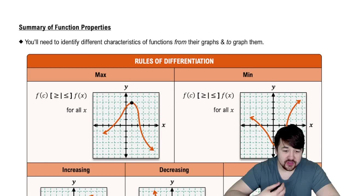
Properties of Functions