2. What change of variables is suggested by an integral containing √(x² + 36)?
Ch. 8 - Integration Techniques
Briggs3rd EditionCalculus: Early TranscendentalsISBN: 9780136847243Non è quello che usi tu?Cambia libro di testo
Capitolo 8, Problema 8.9.16
7–58. Improper integrals Evaluate the following integrals or state that they diverge.
16. ∫ (from -∞ to ∞) (1/(x² + a²)) dx, a > 0
Guida verificata passo dopo passo1
Recognize that the integral is an improper integral over the entire real line from \(-\infty\) to \(\infty\) of the function \(\frac{1}{x^{2} + a^{2}}\), where \(a > 0\).
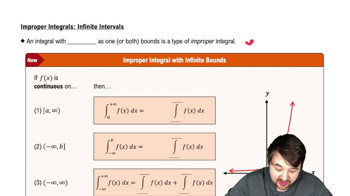
Since the integral is over an infinite interval, rewrite it as a limit: \(\displaystyle \int_{-\infty}^{\infty} \frac{1}{x^{2} + a^{2}} \, dx = \lim_{R \to \infty} \int_{-R}^{R} \frac{1}{x^{2} + a^{2}} \, dx\).
Use the fact that the integrand is an even function, meaning \(f(-x) = f(x)\), so the integral from \(-R\) to \(R\) can be expressed as twice the integral from \(0\) to \(R\): \(\int_{-R}^{R} \frac{1}{x^{2} + a^{2}} \, dx = 2 \int_{0}^{R} \frac{1}{x^{2} + a^{2}} \, dx\).
Recall the antiderivative formula: \(\int \frac{1}{x^{2} + a^{2}} \, dx = \frac{1}{a} \arctan\left( \frac{x}{a} \right) + C\). Use this to evaluate the definite integral from \(0\) to \(R\).
Substitute the limits into the antiderivative, multiply by 2, and then take the limit as \(R \to \infty\) to determine whether the integral converges or diverges.

Risposta video verificata per un problema simile:
Questa soluzione video è stata consigliata dai nostri tutor come utile per risolvere questo problema.
Durata del video:
7mConcetti chiave
Ecco i concetti essenziali che devi comprendere per rispondere correttamente alla domanda.
Improper Integrals
Improper integrals involve integration over infinite intervals or integrands with infinite discontinuities. To evaluate them, limits are used to approach the problematic points, determining if the integral converges to a finite value or diverges.
Video consigliato:
Percorso guidato
Improper Integrals: Infinite Intervals
Integration of Rational Functions
Rational functions are ratios of polynomials. Integrals of the form 1/(x² + a²) are standard and often solved using inverse trigonometric functions, specifically the arctangent, which helps in finding antiderivatives for such expressions.
Video consigliato:
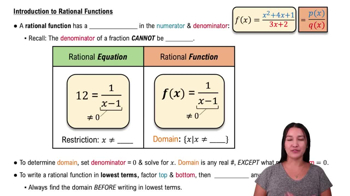
Intro to Rational Functions
Convergence of Integrals over Infinite Limits
When integrating over infinite limits, it is essential to check if the integral converges by evaluating the limit of the integral as the bounds approach infinity. For functions like 1/(x² + a²), the integral converges due to the function's decay rate.
Video consigliato:
Percorso guidato
Improper Integrals: Infinite Intervals
Pratica correlata
Domanda del libro di testo
71
views
Domanda del libro di testo
65. Volume Find the volume of the solid generated when the region bounded by y = sin²(x) * cos^(3/2)(x) and the x-axis on the interval [0, π/2] is revolved about the x-axis.
77
views
Domanda del libro di testo
7–58. Improper integrals Evaluate the following integrals or state that they diverge.
56. ∫ (from 0 to 1) 1/(x + √x) dx
71
views
Domanda del libro di testo
4. Describe the method used to integrate sinᵐx cosⁿx, for m even and n odd.
79
views
Domanda del libro di testo
49–63. {Use of Tech} Integrating with a CAS Use a computer algebra system to evaluate the following integrals. Find both an exact result and an approximate result for each definite integral. Assume a is a positive real number.
58. ∫₀^{2π} dt / (4 + 2 sin t)²
41
views
Domanda del libro di testo
68. Different methods
a. Evaluate ∫(cot x csc² x) dx using the substitution u=cotx.
130
views