Ch. 8 - Integration Techniques
Briggs - Calculus: Early Transcendentals 3rd Edition
Briggs3rd EditionCalculus: Early TranscendentalsISBN: 9780136847243Non è quello che usi tu?Cambia libro di testo
Capitolo 8, Problema 8.1.60

7–64. Integration review Evaluate the following integrals.
60. ∫ from 0 to π/4 of 3√(1 + sin 2x) dx

Guida verificata passo dopo passo
1
Step 1: Recognize that the integral ∫ from 0 to π/4 of 3√(1 + sin(2x)) dx involves a composite function. The term √(1 + sin(2x)) suggests that substitution might simplify the integration process.
Step 2: Use the double-angle identity for sine: sin(2x) = 2sin(x)cos(x). This identity may help simplify the integrand or assist in substitution later.
Step 3: Consider substitution to simplify the integral. Let u = 1 + sin(2x). Then, compute the derivative of u with respect to x: du/dx = 2cos(2x). Rewrite dx in terms of du and substitute into the integral.
Step 4: Adjust the limits of integration. When x = 0, calculate the corresponding value of u using u = 1 + sin(2x). Similarly, when x = π/4, calculate the corresponding value of u. Update the limits of integration accordingly.
Step 5: After substitution, the integral should now be in terms of u and simpler to evaluate. Perform the integration with respect to u, and then back-substitute to return to the original variable if necessary.

Risposta video verificata per un problema simile:

Questa soluzione video è stata consigliata dai nostri tutor come utile per risolvere questo problema.
Durata del video:
4m

Concetti chiave

Ecco i concetti essenziali che devi comprendere per rispondere correttamente alla domanda.

Definite Integrals

A definite integral calculates the accumulation of a quantity, represented as the area under a curve, between two specified limits. In this case, the integral from 0 to π/4 indicates that we are interested in the area under the curve of the function 3√(1 + sin 2x) from x = 0 to x = π/4.
Video consigliato:
Percorso guidato
05:43
Definition of the Definite Integral

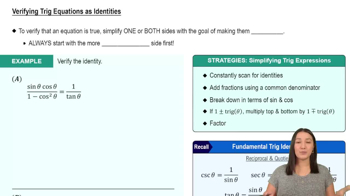
Trigonometric Identities

Trigonometric identities are equations involving trigonometric functions that hold true for all values of the variables. In this integral, the expression sin 2x can be simplified using the double angle identity, which states that sin 2x = 2sin x cos x, aiding in the evaluation of the integral.
Video consigliato:
7:17
Verifying Trig Equations as Identities

Substitution Method

The substitution method is a technique used in integration to simplify the integrand by changing variables. By substituting a new variable for a function of x, the integral can often be transformed into a more manageable form, making it easier to evaluate the definite integral.
Video consigliato:
07:33
Euler's Method