Ch. 8 - Integration Techniques
Briggs - Calculus: Early Transcendentals 3rd Edition
Briggs3rd EditionCalculus: Early TranscendentalsISBN: 9780136847243Non è quello che usi tu?Cambia libro di testo
Capitolo 8, Problema 8.6.11

7–84. Evaluate the following integrals.
11. ∫ from 0 to π/4 (sec x – cos x)² dx

Guida verificata passo dopo passo
1
Step 1: Begin by expanding the integrand (sec(x) - cos(x))² using the algebraic identity (a - b)² = a² - 2ab + b². This gives sec²(x) - 2sec(x)cos(x) + cos²(x).
Step 2: Recall the trigonometric identity sec²(x) = 1 + tan²(x) and substitute it into the integrand. This transforms the expression into (1 + tan²(x)) - 2sec(x)cos(x) + cos²(x).
Step 3: Simplify the integrand further. Note that sec(x)cos(x) simplifies to 1, so the term -2sec(x)cos(x) becomes -2. Combine all terms to get tan²(x) + cos²(x) - 1.
Step 4: Use the Pythagorean identity sin²(x) + cos²(x) = 1 to simplify cos²(x) - 1 into -sin²(x). The integrand now becomes tan²(x) - sin²(x).
Step 5: Split the integral into two separate integrals: ∫ from 0 to π/4 tan²(x) dx - ∫ from 0 to π/4 sin²(x) dx. For tan²(x), use the identity tan²(x) = sec²(x) - 1, and for sin²(x), use the power-reduction formula sin²(x) = (1 - cos(2x))/2. Evaluate each integral step by step.

Risposta video verificata per un problema simile:

Questa soluzione video è stata consigliata dai nostri tutor come utile per risolvere questo problema.
Durata del video:
10m

Concetti chiave

Ecco i concetti essenziali che devi comprendere per rispondere correttamente alla domanda.

Integration

Integration is a fundamental concept in calculus that involves finding the area under a curve represented by a function. It is the reverse process of differentiation and can be understood as summing infinitesimally small quantities. In this context, evaluating the integral requires applying techniques such as substitution or integration by parts to compute the definite integral over the specified limits.
Video consigliato:
Percorso guidato
06:18
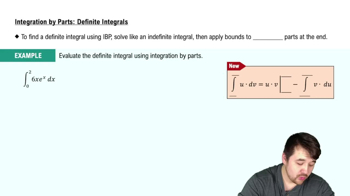
Integration by Parts for Definite Integrals

Trigonometric Functions

Trigonometric functions, such as secant (sec) and cosine (cos), are essential in calculus, particularly when dealing with integrals involving angles. The secant function is defined as the reciprocal of the cosine function, which can lead to simplifications in integrals. Understanding the properties and graphs of these functions is crucial for evaluating integrals that involve them.
Video consigliato:
Percorso guidato
6:04
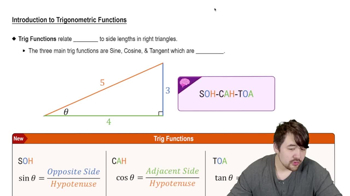
Introduction to Trigonometric Functions

Definite Integrals

A definite integral calculates the accumulation of a quantity, such as area, over a specific interval, defined by upper and lower limits. The result of a definite integral is a numerical value that represents the total area under the curve of the function between these limits. In this problem, evaluating the definite integral from 0 to π/4 requires substituting the limits into the antiderivative of the integrand.
Video consigliato:
Percorso guidato
05:43
Definition of the Definite Integral