Ch. 8 - Integration Techniques
Briggs - Calculus: Early Transcendentals 3rd Edition
Briggs3rd EditionCalculus: Early TranscendentalsISBN: 9780136847243Non è quello che usi tu?Cambia libro di testo
Capitolo 8, Problema 8.6.27

7–84. Evaluate the following integrals.
27. ∫ sin⁴(x/2) dx

Guida verificata passo dopo passo
1
Step 1: Recognize that the integral involves a power of sine, specifically sin⁴(x/2). To simplify this, use the power-reduction formula for sine: sin²(θ) = (1 - cos(2θ))/2. Rewrite sin⁴(x/2) as (sin²(x/2))².
Step 2: Substitute the power-reduction formula for sin²(x/2). Replace sin²(x/2) with (1 - cos(x))/2, since the argument of the sine function is x/2, and the double angle formula applies.
Step 3: Expand (1 - cos(x))/2 squared to get (1/4)(1 - 2cos(x) + cos²(x)). This simplifies the integrand into terms that can be integrated individually.
Step 4: For cos²(x), use the power-reduction formula again: cos²(x) = (1 + cos(2x))/2. Substitute this into the expanded integrand.
Step 5: Break the integral into separate terms: ∫(1/4)dx, ∫(-1/2)cos(x)dx, and ∫(1/8)(1 + cos(2x))dx. Integrate each term individually using basic integration rules for constants and trigonometric functions.

Risposta video verificata per un problema simile:

Questa soluzione video è stata consigliata dai nostri tutor come utile per risolvere questo problema.
Durata del video:
6m

Concetti chiave

Ecco i concetti essenziali che devi comprendere per rispondere correttamente alla domanda.

Integration

Integration is a fundamental concept in calculus that involves finding the accumulated area under a curve represented by a function. It is the reverse process of differentiation and is used to compute quantities such as areas, volumes, and total accumulated change. Understanding the rules and techniques of integration, such as substitution and integration by parts, is essential for evaluating integrals.
Video consigliato:
Percorso guidato
06:18
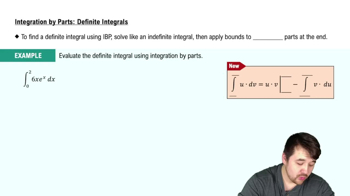
Integration by Parts for Definite Integrals

Trigonometric Functions

Trigonometric functions, such as sine and cosine, are periodic functions that relate angles to ratios of sides in right triangles. In calculus, these functions often appear in integrals and derivatives. Recognizing the properties and identities of trigonometric functions, such as sin²(x) + cos²(x) = 1, is crucial for simplifying expressions and solving integrals involving trigonometric terms.
Video consigliato:
Percorso guidato
6:04
Introduction to Trigonometric Functions

Power Reduction Formulas

Power reduction formulas are trigonometric identities that allow us to express higher powers of sine and cosine in terms of first powers. For example, the formula sin²(x) = (1 - cos(2x))/2 can be used to simplify integrals involving sin⁴(x/2). These formulas are particularly useful in integration, as they transform complex expressions into simpler forms that are easier to integrate.
Video consigliato:
05:58
Intro to Power Series