Ch. 8 - Integration Techniques
Briggs - Calculus: Early Transcendentals 3rd Edition
Briggs3rd EditionCalculus: Early TranscendentalsISBN: 9780136847243Non è quello che usi tu?Cambia libro di testo
Capitolo 8, Problema 8.9.88b

88. Incorrect Calculation
b. Evaluate ∫(from -1 to 1) dx/x or show that the integral does not exist.

Guida verificata passo dopo passo
1
Identify the integral to evaluate: \(\int_{-1}^{1} \frac{dx}{x}\). Notice that the integrand \(\frac{1}{x}\) is undefined at \(x=0\), which lies within the interval of integration.
Since the function is not defined at \(x=0\), split the integral into two improper integrals at the point of discontinuity: \(\int_{-1}^{1} \frac{dx}{x} = \int_{-1}^{0} \frac{dx}{x} + \int_{0}^{1} \frac{dx}{x}\).
Rewrite each integral as a limit to handle the improper nature: \(\int_{-1}^{0} \frac{dx}{x} = \lim_{t \to 0^-} \int_{-1}^{t} \frac{dx}{x}\) and \(\int_{0}^{1} \frac{dx}{x} = \lim_{s \to 0^+} \int_{s}^{1} \frac{dx}{x}\).
Evaluate the antiderivative of \(\frac{1}{x}\), which is \(\ln|x|\), and apply it to each integral before taking the limits.
Examine the behavior of the limits as \(t \to 0^-\) and \(s \to 0^+\) to determine if the integrals converge or diverge. If either limit diverges, conclude that the original integral does not exist.

Risposta video verificata per un problema simile:

Questa soluzione video è stata consigliata dai nostri tutor come utile per risolvere questo problema.
Durata del video:
2m

Concetti chiave

Ecco i concetti essenziali che devi comprendere per rispondere correttamente alla domanda.

Improper Integrals

An improper integral occurs when the integrand is undefined or unbounded within the interval of integration. In this problem, the function 1/x is undefined at x = 0, which lies between -1 and 1, making the integral improper and requiring special evaluation methods.
Video consigliato:
Percorso guidato
11:11
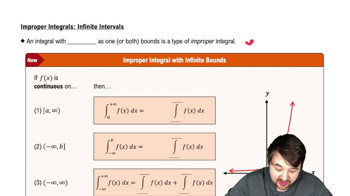
Improper Integrals: Infinite Intervals

Cauchy Principal Value

The Cauchy principal value is a method to assign a finite value to certain improper integrals that are otherwise divergent. For ∫ from -1 to 1 of 1/x dx, the principal value considers symmetric limits approaching zero from both sides, potentially yielding a finite result despite the singularity.
Video consigliato:
Percorso guidato
06:37
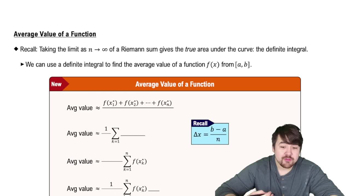
Average Value of a Function

Non-Existence of the Integral

If the limits of the integral do not converge to a finite number due to the singularity, the integral is said not to exist in the usual sense. Since 1/x has an infinite discontinuity at zero, the integral from -1 to 1 diverges unless interpreted as a principal value.
Video consigliato:
03:07
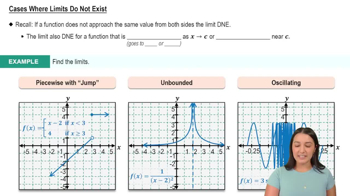
Cases Where Limits Do Not Exist
Pratica correlata
Domanda del libro di testo

58. Two Methods Evaluate ∫(from 0 to π/3) sin(x) · ln(cos(x)) dx in the following two ways:

b. Use substitution.

66
views

Domanda del libro di testo

Let L(c) be the length of the parabola f(x) = x² from x = 0 to x = c, where c ≥ 0 is a constant.

b. Is L concave up or concave down on [0, ∞)?

35
views
Domanda del libro di testo

The Eiffel Tower Property Let R be the region between the curves y = e^(-c·x) and y = -e^(-c·x) on the interval [a, ∞), where a ≥ 0 and c > 0.

The center of mass of R is located at (x̄, 0), where x̄ = [∫(a to ∞) x·e^(-c·x) dx] / [∫(a to ∞) e^(-c·x) dx]

(The profile of the Eiffel Tower is modeled by these two exponential curves; see the Guided Project ""The exponential Eiffel Tower"")

b. With a = 0 and c = 2, find the equations of the lines tangent to both curves at x = 0

58
views
Domanda del libro di testo

Computing areas On the interval [0,2], the graphs of f(x)=x²/3 and g(x)=x²(9−x²)^(-1/2) have similar shapes.

b. Find the area of the region bounded by the graph of g and the x-axis on the interval [0,2].

39
views
Domanda del libro di testo

{Use of Tech} Powers of sine and cosine It can be shown that

∫ from 0 to π/2 of sinⁿx dx = ∫ from 0 to π/2 of cosⁿx dx =

{

[1·3·5···(n-1)]/[2·4·6···n] · π/2 if n ≥ 2 is even

[2·4·6···(n-1)]/[3·5···n] if n ≥ 3 is odd

}

b. Evaluate the integrals with n = 10 and confirm the result.

99
views
Domanda del libro di testo

66–71. {Use of Tech} Estimating error Refer to Theorem 8.1 in the following exercises.

71. Let f(x) = √(sin x).

b. Find an upper bound on the absolute error in the estimate from part (a) using Theorem 8.1. (Hint: |f''''(x)| ≤ 1 on [1,2].)

36
views