Ch. 8 - Integration Techniques
Briggs - Calculus: Early Transcendentals 3rd Edition
Briggs3rd EditionCalculus: Early TranscendentalsISBN: 9780136847243Non è quello che usi tu?Cambia libro di testo
Capitolo 8, Problema 8.6.97

92–98. Evaluate the following integrals.
97. ∫ tan⁻¹(∛x) dx

Guida verificata passo dopo passo
1
Step 1: Recognize that the integral involves the inverse tangent function, tan⁻¹, and a cube root, ∛x. To simplify the integration, consider using substitution. Let u = ∛x, which implies x = u³ and dx = 3u² du.
Step 2: Substitute u = ∛x into the integral. Replace tan⁻¹(∛x) with tan⁻¹(u) and dx with 3u² du. The integral becomes ∫ tan⁻¹(u) * 3u² du.
Step 3: Factor out the constant 3 from the integral to simplify. The integral now becomes 3 ∫ u² * tan⁻¹(u) du.
Step 4: To solve ∫ u² * tan⁻¹(u) du, use integration by parts. Recall the formula for integration by parts: ∫ v dw = uv - ∫ u dv. Let v = tan⁻¹(u) and dw = u² du. Compute dv and u accordingly.
Step 5: After applying integration by parts, simplify the resulting expression. Substitute back u = ∛x to express the solution in terms of x.

Risposta video verificata per un problema simile:

Questa soluzione video è stata consigliata dai nostri tutor come utile per risolvere questo problema.
Durata del video:
4m

Concetti chiave

Ecco i concetti essenziali che devi comprendere per rispondere correttamente alla domanda.

Integration

Integration is a fundamental concept in calculus that involves finding the integral of a function, which represents the area under the curve of that function. It can be thought of as the reverse process of differentiation. There are various techniques for integration, including substitution, integration by parts, and recognizing standard forms.
Video consigliato:
Percorso guidato
06:18
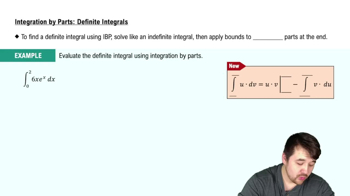
Integration by Parts for Definite Integrals

Inverse Functions

Inverse functions are functions that reverse the effect of the original function. For example, the inverse of the tangent function is the arctangent function, denoted as tan⁻¹(x). Understanding how to work with inverse functions is crucial when integrating functions that involve them, as it often simplifies the integration process.
Video consigliato:
4:49
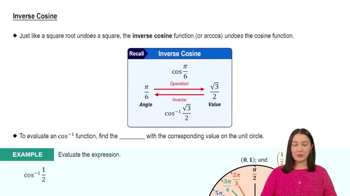
Inverse Cosine

Chain Rule

The chain rule is a fundamental technique in calculus used to differentiate composite functions. When integrating functions that are composed of other functions, such as tan⁻¹(∛x), recognizing the inner function and applying the chain rule can help in simplifying the integral. This rule is essential for correctly applying substitution methods in integration.
Video consigliato:
05:02
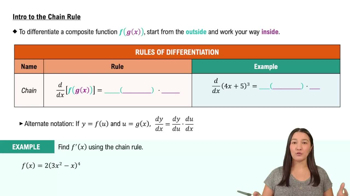
Intro to the Chain Rule
Pratica correlata
Domanda del libro di testo

23-64. Integration Evaluate the following integrals.

62. ∫ 1/[(x + 1)(x² + 2x + 2)²] dx

52
views

Domanda del libro di testo

Use a substitution to reduce the following integrals to ∫ ln u du. Then evaluate using the formula for ∫ ln x dx.

7. ∫ (sec²x) · ln(tan x + 2) dx

111
views
Domanda del libro di testo

7–40. Table look-up integrals Use a table of integrals to evaluate the following indefinite integrals. Some of the integrals require preliminary work, such as completing the square or changing variables, before they can be found in a table.

11. ∫ 3u / (2u + 7) du

40
views
Domanda del libro di testo

{Use of Tech} Using the integral of sec³u By reduction formula 4 in Section 8.3,

∫sec³u du = 1/2 (sec u tan u + ln |sec u + tan u|) + C


Graph the following functions and find the area under the curve on the given interval.

f(x) = 1/(x√(x² - 36)), [12/√3 , 12]

57
views
Domanda del libro di testo

49–52. {Use of Tech} Simpson’s Rule

Apply Simpson’s Rule to the following integrals. It is easiest to obtain the Simpson’s Rule approximations from the Trapezoid Rule approximations, as in Example 8. Make a table similar to Table 8.8 showing the approximations and errors for n = 4, 8, 16, and 32. The exact values of the integrals are given for computing the error.

51. ∫(from 0 to π) e⁻ᵗ sin(t) dt = ½(e⁻ᵖⁱ + 1)

121
views
Domanda del libro di testo

7-56. Trigonometric substitutions Evaluate the following integrals using trigonometric substitution.

44. ∫ 1/√(16 + 4x²) dx

90
views