Ch. 8 - Integration Techniques
Briggs - Calculus: Early Transcendentals 3rd Edition
Briggs3rd EditionCalculus: Early TranscendentalsISBN: 9780136847243Non è quello che usi tu?Cambia libro di testo
Capitolo 8, Problema 8.4.78a

Computing areas On the interval [0,2], the graphs of f(x)=x²/3 and g(x)=x²(9−x²)^(-1/2) have similar shapes.
a. Find the area of the region bounded by the graph of f and the x-axis on the interval [0,2].

Guida verificata passo dopo passo
1
Identify the function and the interval for which you need to find the area. Here, the function is \(f(x) = \frac{x^2}{3}\) and the interval is \([0, 2]\).
Recall that the area under the curve of a function \(f(x)\) from \(a\) to \(b\) is given by the definite integral \(\int_a^b f(x) \, dx\). In this case, you want to compute \(\int_0^2 \frac{x^2}{3} \, dx\).
Set up the integral explicitly: \(\int_0^2 \frac{x^2}{3} \, dx = \frac{1}{3} \int_0^2 x^2 \, dx\). You can factor out the constant \(\frac{1}{3}\) from the integral.
Find the antiderivative of \(x^2\), which is \(\frac{x^3}{3}\). So, the integral becomes \(\frac{1}{3} \left[ \frac{x^3}{3} \right]_0^2\).
Evaluate the definite integral by substituting the upper and lower limits: calculate \(\frac{1}{3} \left( \frac{2^3}{3} - \frac{0^3}{3} \right)\) to express the area bounded by the graph of \(f\) and the x-axis on \([0,2]\).

Risposta video verificata per un problema simile:

Questa soluzione video è stata consigliata dai nostri tutor come utile per risolvere questo problema.
Durata del video:
2m

Concetti chiave

Ecco i concetti essenziali che devi comprendere per rispondere correttamente alla domanda.

Definite Integral as Area Under a Curve

The definite integral of a function over an interval represents the net area between the graph of the function and the x-axis. For a non-negative function, this integral gives the exact area bounded by the curve and the x-axis within the specified limits.
Video consigliato:
Percorso guidato
05:43
Definition of the Definite Integral

Integration of Polynomial Functions

Integrating polynomial functions involves applying the power rule, which states that the integral of x^n is (x^(n+1))/(n+1) plus a constant. This rule simplifies finding antiderivatives for functions like f(x) = x²/3.
Video consigliato:
07:00
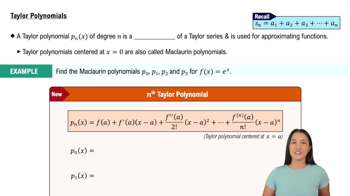
Taylor Polynomials

Evaluating Definite Integrals Using Limits

To compute the definite integral, first find the antiderivative, then evaluate it at the upper and lower bounds of the interval. Subtracting these values yields the exact area under the curve between those points.
Video consigliato:
Percorso guidato
05:43
Definition of the Definite Integral
Pratica correlata
Domanda del libro di testo

85. Explain why or why not Determine whether the following statements are true and give an explanation or counterexample.

a. More than one integration method can be used to evaluate ∫ (1 / (1 - x²)) dx.

46
views

Domanda del libro di testo

63. Explain why or why not Determine whether the following statements are true and give an explanation or counterexample.

a. If m is a positive integer, then ∫[0 to π] cos^(2m+1)(x) dx = 0.

65
views
Domanda del libro di testo

75. {Use of Tech} Oscillator displacements Suppose a mass on a spring that is slowed by friction has the position function:

s(t) = e⁻ᵗ sin t

a. Graph the position function. At what times does the oscillator pass through the position s = 0?

53
views
Domanda del libro di testo

42. Approximating integrals The function f is twice differentiable on (-∞, ∞). Values of f at various points on [0, 20] are given in the table.

a. Approximate ∫(0 to 120) f(x) dx in three way using a left Riemann sum, a right Riemann sum and the Trapezoid Rule

58
views
Domanda del libro di testo

81. Possible and impossible integrals

Let Iₙ = ∫ xⁿ e⁻ˣ² dx, where n is a nonnegative integer.

a. I₀ = ∫ e⁻ˣ² dx cannot be expressed in terms of elementary functions. Evaluate I₁.

60
views
Domanda del libro di testo

66–71. {Use of Tech} Estimating error Refer to Theorem 8.1 in the following exercises.

67. Let f(x) = √(x³ + 1).

a. Find a Midpoint Rule approximation to ∫[1 to 6] √(x³ + 1) dx using n = 50 subintervals.

38
views