Ch. 8 - Integration Techniques
Briggs - Calculus: Early Transcendentals 3rd Edition
Briggs3rd EditionCalculus: Early TranscendentalsISBN: 9780136847243Non è quello che usi tu?Cambia libro di testo
Capitolo 8, Problema 8.6.68

Evaluate the following integrals.
∫ eˣ/(e²ˣ + 2eˣ + 17) dx

Guida verificata passo dopo passo
1
Step 1: Observe the integral ∫ eˣ/(e²ˣ + 2eˣ + 17) dx. Notice that the denominator is a quadratic expression in terms of eˣ. Rewrite the denominator as (eˣ)² + 2(eˣ) + 17 to make the structure clearer.
Step 2: Perform a substitution to simplify the integral. Let u = eˣ, which implies that du = eˣ dx. This substitution transforms the integral into ∫ u/(u² + 2u + 17) du.
Step 3: Analyze the new integral ∫ u/(u² + 2u + 17) du. Factorize or complete the square for the quadratic expression in the denominator. Rewrite u² + 2u + 17 as (u + 1)² + 16.
Step 4: Rewrite the integral using the completed square form: ∫ u/((u + 1)² + 16) du. Consider splitting the numerator u into two terms: (u + 1) - 1, so the integral becomes ∫ [(u + 1)/((u + 1)² + 16) - 1/((u + 1)² + 16)] du.
Step 5: Break the integral into two parts: ∫ (u + 1)/((u + 1)² + 16) du and ∫ -1/((u + 1)² + 16) du. Use standard integration techniques for these forms, such as recognizing the derivative of the denominator for the first term and using the arctangent formula for the second term.

Risposta video verificata per un problema simile:

Questa soluzione video è stata consigliata dai nostri tutor come utile per risolvere questo problema.
Durata del video:
4m

Concetti chiave

Ecco i concetti essenziali che devi comprendere per rispondere correttamente alla domanda.

Integration Techniques

Integration techniques are methods used to find the integral of a function. Common techniques include substitution, integration by parts, and partial fraction decomposition. Understanding these methods is crucial for evaluating complex integrals, such as the one presented, where a rational function is involved.
Video consigliato:
Percorso guidato
06:18
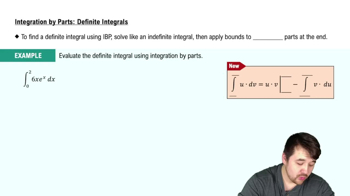
Integration by Parts for Definite Integrals

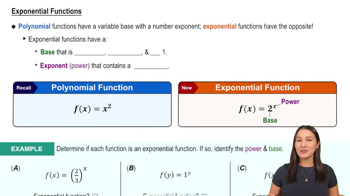
Exponential Functions

Exponential functions are mathematical functions of the form f(x) = e^x, where e is Euler's number (approximately 2.718). These functions have unique properties, such as their derivatives being equal to the function itself. Recognizing the behavior of exponential functions is essential when integrating expressions that involve e^x.
Video consigliato:
6:13
Exponential Functions

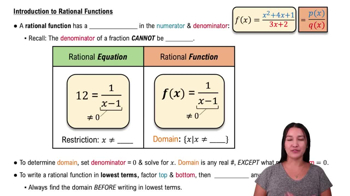
Rational Functions

A rational function is a ratio of two polynomials. In the integral provided, the denominator is a polynomial that can be factored or simplified to aid in integration. Understanding how to manipulate and simplify rational functions is key to solving integrals that involve them, especially when combined with exponential terms.
Video consigliato:
6:04
Intro to Rational Functions