
Ch. 8 - Integration Techniques
Briggs - Calculus: Early Transcendentals 3rd Edition
Briggs3rd EditionCalculus: Early TranscendentalsISBN: 9780136847243Non è quello che usi tu?Cambia libro di testo
Capitolo 8, Problema 8.1.65a

Explain why or why not Determine whether the following statements are true and give an explanation or counterexample.
a. ∫(3/(x² + 4)) dx = ∫(3/x²) dx + ∫(3/4) dx.

Guida verificata passo dopo passo
1
Recall the property of integrals that states \( \int (f(x) + g(x)) \, dx = \int f(x) \, dx + \int g(x) \, dx \). This means the integral of a sum is the sum of the integrals, but this property does not apply to quotients or products inside the integral unless they are separated as sums.
Look carefully at the given integral: \( \int \frac{3}{x^2 + 4} \, dx \). The denominator is \( x^2 + 4 \), which is a sum inside the denominator, not a sum of two separate fractions.
The statement claims that \( \int \frac{3}{x^2 + 4} \, dx = \int \frac{3}{x^2} \, dx + \int \frac{3}{4} \, dx \). This would mean splitting the fraction \( \frac{3}{x^2 + 4} \) into \( \frac{3}{x^2} + \frac{3}{4} \), which is not algebraically correct because \( \frac{1}{a + b} \neq \frac{1}{a} + \frac{1}{b} \).
To verify, consider a counterexample by choosing a specific value of \( x \), for example \( x = 1 \), and compare \( \frac{3}{1^2 + 4} = \frac{3}{5} \) with \( \frac{3}{1^2} + \frac{3}{4} = 3 + \frac{3}{4} = \frac{15}{4} \). Since these are not equal, the equality inside the integral does not hold.
Therefore, the original statement is false because the integral of a quotient with a sum in the denominator cannot be split into the sum of integrals of separate fractions as claimed.

Risposta video verificata per un problema simile:

Questa soluzione video è stata consigliata dai nostri tutor come utile per risolvere questo problema.
Durata del video:
2m

Concetti chiave

Ecco i concetti essenziali che devi comprendere per rispondere correttamente alla domanda.

Linearity of Integration

Integration is a linear operation, meaning the integral of a sum is the sum of the integrals. However, this property applies only when the integrand is expressed as a sum of separate terms, not when terms are combined inside a single denominator.
Video consigliato:

Properties of Rational Functions

A rational function is a ratio of polynomials. Splitting an integral like ∫(3/(x² + 4)) dx into ∫(3/x²) dx + ∫(3/4) dx is incorrect because (x² + 4) is a single denominator, not a sum of separate fractions.
Video consigliato:
Percorso guidato
06:21
Properties of Functions

Counterexamples in Integration

To test if an integral equality holds, substituting specific values or comparing derivatives can provide counterexamples. Here, evaluating or differentiating the proposed split shows it does not equal the original integral, disproving the statement.
Video consigliato:
Percorso guidato
06:18
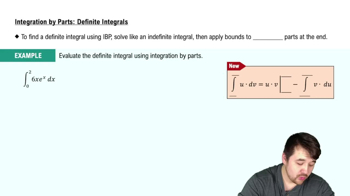
Integration by Parts for Definite Integrals