Ch. 8 - Integration Techniques
Briggs - Calculus: Early Transcendentals 3rd Edition
Briggs3rd EditionCalculus: Early TranscendentalsISBN: 9780136847243Non è quello che usi tu?Cambia libro di testo
Capitolo 8, Problema 8.8.53a

Explain why or why not Determine whether the following statements are true and give an explanation or counterexample.
a. Suppose ∫_a^b f(x) dx is approximated with Simpson’s Rule using n = 18 subintervals, where |f^(4)(x)| ≤ 1 on [a, b]. The absolute error E_S in approximating the integral satisfies E_S ≤ (Δx)^5 / 10.

Guida verificata passo dopo passo
1
Recall the error bound formula for Simpson's Rule: the absolute error \( E_S \) satisfies \( |E_S| \leq \frac{(b - a)}{180} (\Delta x)^4 \max_{x \in [a,b]} |f^{(4)}(x)| \), where \( \Delta x = \frac{b - a}{n} \) and \( n \) is the number of subintervals (which must be even).
Identify the given values: \( n = 18 \), \( |f^{(4)}(x)| \leq 1 \) on \( [a,b] \), and \( \Delta x = \frac{b - a}{18} \).
Substitute \( \max |f^{(4)}(x)| = 1 \) and \( \Delta x = \frac{b - a}{18} \) into the error bound formula to express \( E_S \) in terms of \( (b - a) \) and \( \Delta x \).
Compare the given inequality \( E_S \leq \frac{(\Delta x)^5}{10} \) with the standard error bound formula to check if it holds for all \( (b - a) \) and \( n = 18 \).
Conclude whether the statement is true or false by analyzing if the given bound is consistent with the known error bound for Simpson's Rule, providing a counterexample if it is not.

Risposta video verificata per un problema simile:

Questa soluzione video è stata consigliata dai nostri tutor come utile per risolvere questo problema.
Durata del video:
5m

Concetti chiave

Ecco i concetti essenziali che devi comprendere per rispondere correttamente alla domanda.

Simpson's Rule and its Error Bound

Simpson's Rule approximates definite integrals by fitting parabolas through subinterval points. The error bound depends on the fourth derivative of the function and the number of subintervals n. Specifically, the error is proportional to the maximum of |f⁽⁴⁾(x)| on [a, b] and inversely proportional to n⁴, reflecting how finer partitions improve accuracy.
Video consigliato:
05:02
Intro to the Chain Rule

Role of the Fourth Derivative in Error Estimation

The fourth derivative of the function, f⁽⁴⁾(x), measures the function's smoothness and curvature changes. In Simpson's Rule, the error bound involves the maximum absolute value of f⁽⁴⁾(x) over the interval, as this derivative controls how well parabolas approximate the function. A smaller maximum leads to a smaller error.
Video consigliato:
Percorso guidato
05:59
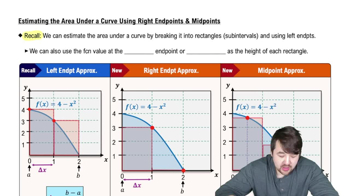
Estimating the Area Under a Curve with Right Endpoints & Midpoint

Relationship Between Subinterval Width Δx and Number of Subintervals n

The subinterval width Δx is defined as (b - a)/n, linking the number of subintervals n to the partition size. Since the error bound in Simpson's Rule involves Δx raised to the fifth power, increasing n (thus decreasing Δx) significantly reduces the error, highlighting the importance of choosing an appropriate n for desired accuracy.
Video consigliato:
Percorso guidato
06:11
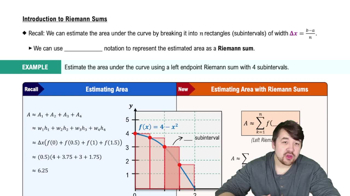
Introduction to Riemann Sums