
Domanda del libro di testo
A family of exponential functions
b. Verify that the arc length of the curve y=f(x) on the interval [0, ln 2] is A(2^a-1) - 1/4a²A (2^-a - 1).
60
views

 Guida verificata passo dopo passo
 07:39
07:39
 05:03
05:03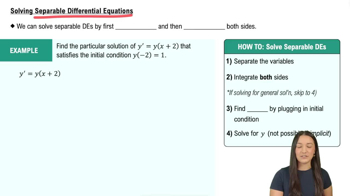 06:06
06:06A family of exponential functions
b. Verify that the arc length of the curve y=f(x) on the interval [0, ln 2] is A(2^a-1) - 1/4a²A (2^-a - 1).
39–42. Special equations A special class of first-order linear equations have the form a(t)y'(t)+a'(t)y(t)=f(t), where a and f are given functions of t. Notice that the left side of this equation can be written as the derivative of a product, so the equation has the form
a(t)y'(t) + a'(t)y(t) = d/dt (a(t)y(t)) = f(t).
Therefore, the equation can be solved by integrating both sides with respect to t. Use this idea to solve the following initial value problems.
(t² + 1)y′(t) + 2ty = 3t², y(2) = 8
23–26. Loan problems The following initial value problems model the payoff of a loan. In each case, solve the initial value problem, for t≥0 graph the solution, and determine the first month in which the loan balance is zero.
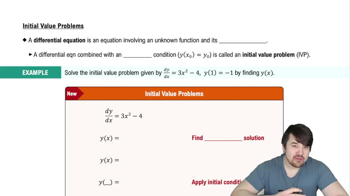
B′(t) = 0.004B − 800, B(0) = 40,000
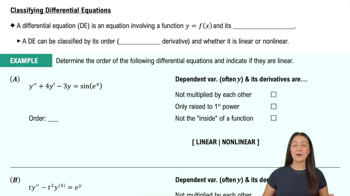
Does the function y(t) = 2t satisfy the differential equation y'''(t) + y'(t) = 2?
17–32. Solving initial value problems Determine whether the following equations are separable. If so, solve the initial value problem.
y'(t) = yeᵗ, y(0) = −1