Ch. 9 - Differential Equations
Briggs - Calculus: Early Transcendentals 3rd Edition
Briggs3rd EditionCalculus: Early TranscendentalsISBN: 9780136847243Non è quello che usi tu?Cambia libro di testo
Capitolo 9, Problema 9.3.38

33–38. {Use of Tech} Solutions in implicit form Solve the following initial value problems and leave the solution in implicit form. Use graphing software to plot the solution. If the implicit solution describes more than one function, be sure to indicate which function corresponds to the solution of the initial value problem.
z(x) = (z² + 4)/(x² + 16), z(4) = 2

Guida verificata passo dopo passo
1
Rewrite the given differential equation in the form \( \frac{dz}{dx} = \frac{z^2 + 4}{x^2 + 16} \) to clearly identify the derivative \( \frac{dz}{dx} \).
Separate the variables by rearranging terms to isolate \( z \) on one side and \( x \) on the other: \( \frac{dz}{z^2 + 4} = \frac{dx}{x^2 + 16} \).
Integrate both sides: compute \( \int \frac{dz}{z^2 + 4} \) and \( \int \frac{dx}{x^2 + 16} \). Recall that \( \int \frac{du}{u^2 + a^2} = \frac{1}{a} \arctan\left(\frac{u}{a}\right) + C \).
After integrating, write the implicit solution by equating the two antiderivatives plus a constant of integration \( C \): \( \frac{1}{2} \arctan\left(\frac{z}{2}\right) = \frac{1}{4} \arctan\left(\frac{x}{4}\right) + C \).
Use the initial condition \( z(4) = 2 \) to solve for the constant \( C \), then express the implicit solution including this constant. This implicit equation represents the solution to the initial value problem.

Risposta video verificata per un problema simile:

Questa soluzione video è stata consigliata dai nostri tutor come utile per risolvere questo problema.
Durata del video:
3m

Concetti chiave

Ecco i concetti essenziali che devi comprendere per rispondere correttamente alla domanda.

Implicit Solutions of Differential Equations

An implicit solution is a relation involving both the dependent and independent variables that satisfies the differential equation without explicitly solving for the dependent variable. Such solutions may define multiple functions, and additional conditions help identify the specific solution relevant to the initial value problem.
Video consigliato:
05:09
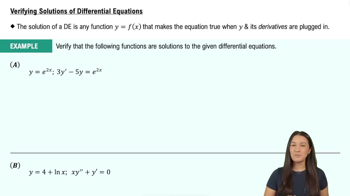
Verifying Solutions of Differential Equations

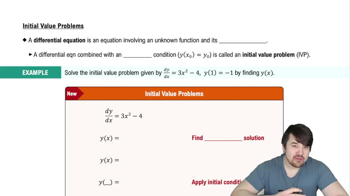
Initial Value Problems (IVPs)

An initial value problem specifies a differential equation along with a condition that the solution must satisfy at a particular point. This condition allows us to determine the unique solution curve among many possible implicit or explicit solutions.
Video consigliato:
Percorso guidato
05:03
Initial Value Problems

Use of Technology for Graphing Solutions

Graphing software helps visualize implicit solutions that are difficult to solve explicitly. By plotting the implicit relation and applying the initial condition, one can identify the correct solution branch and better understand the behavior of the solution.
Video consigliato:
Percorso guidato
06:15
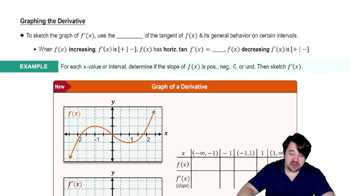
Graphing The Derivative
Pratica correlata
Domanda del libro di testo

21–32. Finding general solutions Find the general solution of each differential equation. Use C,C1,C2... to denote arbitrary constants.

p'(x) = 16/x⁹ - 5 + 14x⁶

144
views

Domanda del libro di testo

5–16. Solving separable equations Find the general solution of the following equations. Express the solution explicitly as a function of the independent variable.

(t² + 1)³yy'(t) = t(y² + 4)

57
views
Domanda del libro di testo

33–38. {Use of Tech} Solutions in implicit form Solve the following initial value problems and leave the solution in implicit form. Use graphing software to plot the solution. If the implicit solution describes more than one function, be sure to indicate which function corresponds to the solution of the initial value problem.

y'(t) = 2t²/(y² − 1), y(0) = 0

41
views
Domanda del libro di testo

21–24. Logistic equations Consider the following logistic equations. In each case, sketch the direction field, draw the solution curve for each initial condition, and find the equilibrium solutions. A detailed direction field is not needed. Assume t ≥ 0 and tP ≥ 0.

P′(t) = 0.05P − 0.001P²; P(0) = 10, P(0) = 40, P(0) = 80

44
views
Domanda del libro di testo

Case 2 of the general solution Solve the equation y′(t) = ky + b in the case that ky + b < 0 and verify that the general solution is y(t) = Ceᵏᵗ − b/k.

63
views
Domanda del libro di testo

5–16. Solving separable equations Find the general solution of the following equations. Express the solution explicitly as a function of the independent variable.

e⁴ᵗy'(t) = 5

65
views