
Ch. 9 - Differential Equations
Briggs - Calculus: Early Transcendentals 3rd Edition
Briggs3rd EditionCalculus: Early TranscendentalsISBN: 9780136847243Non è quello che usi tu?Cambia libro di testo
Capitolo 9, Problema 9.2.43a

38–43. Equilibrium solutions A differential equation of the form y′(t)=f(y) is said to be autonomous (the function f depends only on y). The constant function y=y0 is an equilibrium solution of the equation provided f(y0)=0 (because then y'(t)=0 and the solution remains constant for all t). Note that equilibrium solutions correspond to horizontal lines in the direction field. Note also that for autonomous equations, the direction field is independent of t. Carry out the following analysis on the given equations.
a. Find the equilibrium solutions. 


y′(t) = y(y - 3)(y + 2)

Guida verificata passo dopo passo
1
Identify the given autonomous differential equation: \(y'(t) = y(y - 3)(y + 2)\).
Recall that equilibrium solutions occur where the derivative \(y'(t)\) is zero for all \(t\), meaning \(f(y) = 0\).
Set the right-hand side equal to zero: \(y(y - 3)(y + 2) = 0\).
Solve the equation \(y(y - 3)(y + 2) = 0\) by finding the values of \(y\) that make each factor zero.
The solutions to this equation give the equilibrium solutions \(y = 0\), \(y = 3\), and \(y = -2\).

Risposta video verificata per un problema simile:

Questa soluzione video è stata consigliata dai nostri tutor come utile per risolvere questo problema.
Durata del video:
1m

Concetti chiave

Ecco i concetti essenziali che devi comprendere per rispondere correttamente alla domanda.

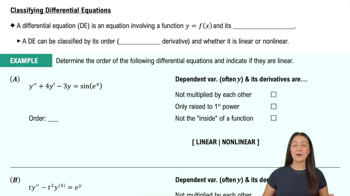
Autonomous Differential Equations

An autonomous differential equation is one where the derivative y' depends only on the variable y, not explicitly on the independent variable t. This means the rate of change of y depends solely on y itself, simplifying analysis and allowing the use of phase line methods.
Video consigliato:
07:39
Classifying Differential Equations

Equilibrium Solutions

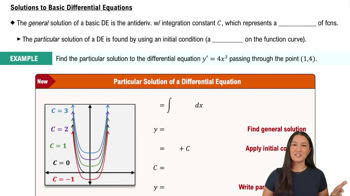
Equilibrium solutions occur when y' = 0, meaning the function y(t) remains constant over time. For autonomous equations, these are found by solving f(y) = 0. Graphically, equilibrium solutions correspond to horizontal lines in the direction field where the slope is zero.
Video consigliato:
04:00
Solutions to Basic Differential Equations

Factoring and Solving Polynomial Equations

To find equilibrium points in equations like y' = y(y - 3)(y + 2), factor the right-hand side and set each factor equal to zero. Solving these polynomial equations yields the constant values of y where the system is in equilibrium.
Video consigliato:
5:02
Solving Logarithmic Equations
Pratica correlata
Domanda del libro di testo

23–26. Stirred tank reactions For each of the following stirred tank reactions, carry out the following analysis.

a. Write an initial value problem for the mass of the substance.


A one-million-liter pond is contaminated by a chemical pollutant with a concentration of 20 g/L. The source of the pollutant is removed, and pure water is allowed to flow into the pond at a rate of 1200 L/hr. Assuming the pond is thoroughly mixed and drained at a rate of 1200 L/hr, how long does it take to reduce the concentration of the solution in the pond to 10% of the initial value?

36
views
Domanda del libro di testo

Direction field analysis Consider the first-order initial value problem y'(t)=ay+b,y(0)=A for t≥0 where a, b, and A are real numbers.

a. Explain why y=−b/a is an equilibrium solution and corresponds to a horizontal line in the direction field.

57
views
Domanda del libro di testo

52-56. In this section, several models are presented and the solution of the associated differential equation is given. Later in the chapter, we present methods for solving these differential equations.


where P(t) is the population, for t ≥ 0, and r > 0 and K > 0 are given constants.


a. Verify by substitution that the general solution of the equation is P(t) = K/(1 + Ce⁻ʳᵗ), where C is an arbitrary constant.

57
views
Domanda del libro di testo

{Use of Tech} Chemical rate equations Let y(t) be t he concentration of a substance in a chemical reaction (typical units are moles/liter). The change in the concentration, under appropriate conditions, is modeled by the equation dy/dt=-ky^n for t≥0, where k>0 is a rate constant and the positive integer n is the order of the reaction.

b. Solve the initial value problem for a second-order reaction (n=2) assuming y(0)=y0.

42
views
Domanda del libro di testo

Convergence of Euler's method Suppose Euler's method is applied to the initial value problem y′(t) = ay, y(0) = 1, which has the exact solution y(t) = eᵃᵗ. For this exercise, let h denote the time step (rather than Δt). The grid points are then given by tₖ = kh. We let uₖ be the Euler approximation to the exact solution y(tₖ), for k = 0, 1, 2, ...

b. Show by substitution that uₖ = (1 + ah)ᵏ is a solution of the equations in part (a), for k = 0, 1, 2, ...

65
views
Domanda del libro di testo

Solving Bernoulli equations Use the method outlined in Exercise 43 to solve the following Bernoulli equations.


a. y′(t) + y = 2y²

125
views