
Ch. 9 - Differential Equations
Briggs - Calculus: Early Transcendentals 3rd Edition
Briggs3rd EditionCalculus: Early TranscendentalsISBN: 9780136847243Non è quello che usi tu?Cambia libro di testo
Capitolo 9, Problema 9.1.53d

52-56. In this section, several models are presented and the solution of the associated differential equation is given. Later in the chapter, we present methods for solving these differential equations.


where P(t) is the population, for t ≥ 0, and r > 0 and K > 0 are given constants.


d. Find lim(t→∞) P(t) and check that the result is consistent with the graph in part (c).

Guida verificata passo dopo passo
1
Identify the differential equation model given for the population $P(t)\(, which is typically the logistic growth model: \[\frac{dP}{dt} = rP\left(1 - \frac{P}{K}\right),\] where \)r > 0$ is the growth rate and \(K > 0\) is the carrying capacity.
Understand that the equilibrium solutions occur when the growth rate is zero, i.e., when \[\frac{dP}{dt} = 0.\] This happens if either \(P = 0\) or \(P = K\).
Analyze the stability of these equilibrium points: since \(r > 0\), \(P = 0\) is an unstable equilibrium and \(P = K\) is a stable equilibrium, meaning the population tends to \(K\) as \(t \to \infty\).
Therefore, to find \[\lim_{t \to \infty} P(t),\] recognize that the solution \(P(t)\) approaches the stable equilibrium \(K\) over time.
Finally, verify that this limit is consistent with the graph in part (c), which should show the population leveling off at the carrying capacity \(K\) as time increases.

Risposta video verificata per un problema simile:

Questa soluzione video è stata consigliata dai nostri tutor come utile per risolvere questo problema.
Durata del video:
2m

Concetti chiave

Ecco i concetti essenziali che devi comprendere per rispondere correttamente alla domanda.

Logistic Differential Equation

The logistic differential equation models population growth with a carrying capacity, expressed as dP/dt = rP(1 - P/K). Here, P(t) is the population at time t, r is the growth rate, and K is the maximum sustainable population. Understanding this equation helps analyze how populations grow and stabilize over time.
Video consigliato:
07:39
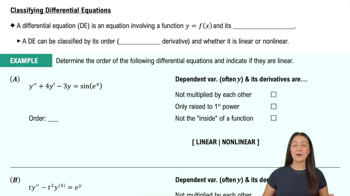
Classifying Differential Equations

Limit of a Function as t Approaches Infinity

The limit lim(t→∞) P(t) describes the long-term behavior of the population. Evaluating this limit reveals the steady-state or equilibrium population size. In logistic growth, this limit typically equals the carrying capacity K, indicating population stabilization.
Video consigliato:
06:11
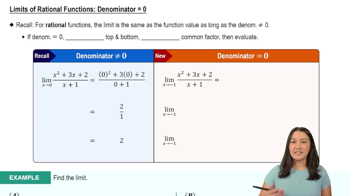
Limits of Rational Functions: Denominator = 0

Equilibrium Solutions and Stability

Equilibrium solutions occur when the population does not change over time (dP/dt = 0). For the logistic model, P = 0 and P = K are equilibria. Stability analysis shows that P = K is stable, meaning the population tends to this value as t increases, consistent with the graph's behavior.
Video consigliato:
04:00
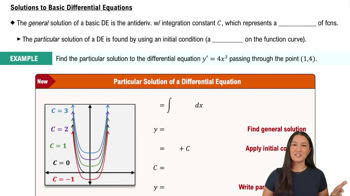
Solutions to Basic Differential Equations
Pratica correlata
Domanda del libro di testo

U.S. population projections According to the U.S. Census Bureau, the nation’s population (to the nearest million) was 296 million in 2005 and 321 million in 2015. The Bureau also projects a 2050 population of 398 million. To construct a logistic model, both the growth rate and the carrying capacity must be estimated. There are several ways to estimate these parameters. Here is one approach:


d. Estimations of this kind must be made and interpreted carefully. Suppose the projected population for 2050 is 410 million rather than 398 million. What is the value of the carrying capacity in this case?

65
views
Domanda del libro di testo

A physiological model A common assumption in modeling drug assimilation is that the blood volume in a person is a single compartment that behaves like a stirred tank. Suppose the blood volume is a four-liter tank that initially has a zero concentration of a particular drug. At time t = 0, an intravenous line is inserted into a vein (into the tank) that carries a drug solution with a concentration of 500 mg/L. The inflow rate is 0.06 L/min. Assume the drug is quickly mixed thoroughly in the blood and that the volume of blood remains constant.

d. After how many minutes does the drug mass reach 90% of its steady-state level? 

45
views
Domanda del libro di testo

33–36. {Use of Tech} Computing Euler approximations Use a calculator or computer program to carry out the following steps.

d. Compare the errors in the approximations to y(T).


y′(t) = 6 - 2y, y(0) = -1; Δt = 0.2, T = 3; y(t) = 3 - 4e⁻²ᵗ

54
views
Domanda del libro di testo

27–30. Predator-prey models Consider the following pairs of differential equations that model a predator-prey system with populations x and y. In each case, carry out the following steps.

d. Identify the four regions in the first quadrant of the xy-plane in which x' and y' are positive or negative.


x′(t) = 2x − 4xy, y′(t) = −y + 2xy

43
views
Domanda del libro di testo

A second-order equation Consider the differential equation y''(t) - k²y(t) = 0 where k > 0 is a real number.


d. For a positive real number k, verify that the general solution of the equation may also be expressed in the form y(t) = C₁cosh(kt) + C₂sinh(kt), where cosh and sinh are the hyperbolic cosine and hyperbolic sine, respectively (Section 7.3).

77
views
Domanda del libro di testo

17–20. Increasing and decreasing solutions Consider the following differential equations. A detailed direction field is not needed.


d. Sketch the direction field and verify that it is consistent with parts (a)–(c).


y'(t) = (y−2)(y+1)

32
views