Ch. 9 - Differential Equations
Briggs - Calculus: Early Transcendentals 3rd Edition
Briggs3rd EditionCalculus: Early TranscendentalsISBN: 9780136847243Non è quello che usi tu?Cambia libro di testo
Capitolo 9, Problema 9.3.4

Explain how to solve a separable differential equation of the form
g(t)y'(y) = h(t)

Guida verificata passo dopo passo
1
Identify the given differential equation: \( g(t) y'(y) = h(t) \). Note that \( y' \) typically denotes \( \frac{dy}{dt} \), so clarify the variables involved and the form of the equation.
Rewrite the equation to isolate \( \frac{dy}{dt} \). Since \( y' = \frac{dy}{dt} \), express the equation as \( g(t) \frac{dy}{dt} = h(t) \).
Separate the variables by rewriting the equation so that all terms involving \( y \) are on one side and all terms involving \( t \) are on the other. This might involve dividing both sides by \( g(t) \) and expressing \( \frac{dy}{dt} \) explicitly.
Integrate both sides with respect to their respective variables: integrate the \( y \)-side with respect to \( y \) and the \( t \)-side with respect to \( t \). This step uses the principle that \( \int dy = \int \frac{h(t)}{g(t)} dt \).
After integration, include the constant of integration \( C \) and solve for \( y \) explicitly if possible, to find the general solution to the differential equation.

Risposta video verificata per un problema simile:

Questa soluzione video è stata consigliata dai nostri tutor come utile per risolvere questo problema.
Durata del video:
3m

Concetti chiave

Ecco i concetti essenziali che devi comprendere per rispondere correttamente alla domanda.

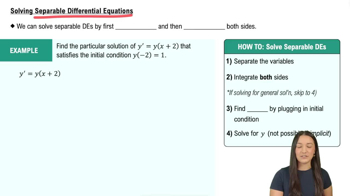
Separable Differential Equations

A separable differential equation can be written so that all terms involving one variable and its derivative are on one side, and all terms involving the other variable are on the opposite side. This allows the equation to be integrated separately with respect to each variable, simplifying the solution process.
Video consigliato:
06:06
Solving Separable Differential Equations

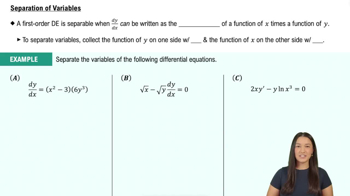
Separation of Variables Technique

This technique involves algebraically manipulating the differential equation to isolate y and dy on one side and t and dt on the other. Once separated, both sides are integrated independently, leading to an implicit or explicit solution for y in terms of t.
Video consigliato:
07:15
Separation of Variables

Integration of Both Sides

After separating variables, integrating each side with respect to its variable is essential. This step often involves finding antiderivatives of functions g(t) and h(t), and may include adding an integration constant, which represents the family of solutions to the differential equation.
Video consigliato:
05:50
One-Sided Limits
Pratica correlata
Domanda del libro di testo

33–42. Solving initial value problems Solve the following initial value problems.

p'(x) = 2/(x² + x), p(1) = 0

48
views

Domanda del libro di testo

45–46. Harvesting problems Consider the harvesting problem in Example 6.

If r = 0.05 and H = 500, for what values of p₀ is the amount of the resource decreasing? For what value of p₀ is the amount of the resource constant? If p₀ = 9000, when does the resource vanish?

48
views
Domanda del libro di testo

11–16. Initial value problems Solve the following initial value problems.


y'(t) − 3y = 12, y(1) = 4

46
views
Domanda del libro di testo

39–42. Special equations A special class of first-order linear equations have the form a(t)y'(t)+a'(t)y(t)=f(t), where a and f are given functions of t. Notice that the left side of this equation can be written as the derivative of a product, so the equation has the form

a(t)y'(t) + a'(t)y(t) = d/dt (a(t)y(t)) = f(t). 

Therefore, the equation can be solved by integrating both sides with respect to t. Use this idea to solve the following initial value problems. 


(t² + 1)y′(t) + 2ty = 3t², y(2) = 8

48
views
Domanda del libro di testo

23–26. Loan problems The following initial value problems model the payoff of a loan. In each case, solve the initial value problem, for t≥0 graph the solution, and determine the first month in which the loan balance is zero.


B′(t) = 0.004B − 800, B(0) = 40,000

40
views
Domanda del libro di testo

Stability of Euler's method Consider the initial value problem y′(t) = −ay, y(0) = 1 where a > 0; it has the exact solution y(t) = e⁻ᵃᵗ, which is a decreasing function.


a. Show that Euler's method applied to this problem with time step h can be written u₀ = 1, uₖ₊₁ = (1 − ah)uₖ for k = 0, 1, 2, ...


b. Show by substitution that uₖ = (1 − ah)ᵏ is a solution of the equations in part (a), for k = 0, 1, 2, ...

67
views