Ch. 9 - Differential Equations
Briggs - Calculus: Early Transcendentals 3rd Edition
Briggs3rd EditionCalculus: Early TranscendentalsISBN: 9780136847243Non è quello che usi tu?Cambia libro di testo
Capitolo 9, Problema 9.1.6

Explain why the graph of the solution to the initial value problem y'(t) = t²/(1 - t), y(-1) = ln 2 cannot cross the line t = 1.

Guida verificata passo dopo passo
1
Identify the differential equation given: \(y'(t) = \frac{t^2}{1 - t}\).
Notice that the denominator \(1 - t\) becomes zero at \(t = 1\), which means the right-hand side of the differential equation is undefined at \(t = 1\).
Since the derivative \(y'(t)\) is not defined at \(t = 1\), the solution \(y(t)\) cannot be extended continuously through \(t = 1\); this creates a vertical asymptote or a discontinuity in the slope.
The initial condition \(y(-1) = \ln 2\) is given at \(t = -1\), which is less than 1, so the solution is defined on an interval containing \(-1\) but cannot cross the point where the derivative is undefined, \(t = 1\).
Therefore, the graph of the solution cannot cross the vertical line \(t = 1\) because the differential equation does not allow the solution to be differentiable or continuous at that point.

Risposta video verificata per un problema simile:

Questa soluzione video è stata consigliata dai nostri tutor come utile per risolvere questo problema.
Durata del video:
2m

Concetti chiave

Ecco i concetti essenziali che devi comprendere per rispondere correttamente alla domanda.

Existence and Uniqueness Theorem

This theorem states that if the function defining the differential equation and its partial derivative with respect to y are continuous near the initial condition, then a unique solution exists locally. It ensures the solution behaves predictably and helps identify points where the solution may fail to extend.
Video consigliato:
Percorso guidato
06:11
Fundamental Theorem of Calculus Part 1

Domain of the Differential Equation

The domain is the set of t-values where the function defining y' is defined and continuous. Since y'(t) = t²/(1 - t) has a denominator that becomes zero at t = 1, the function is undefined there, creating a vertical asymptote or discontinuity that the solution cannot cross.
Video consigliato:
07:39
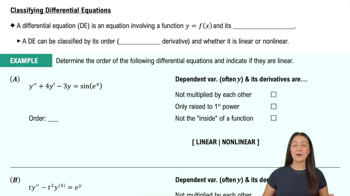
Classifying Differential Equations

Behavior Near Singularities

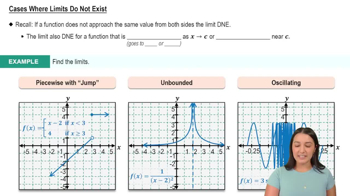
When the differential equation has singularities (points where it is undefined), solutions often approach these points asymptotically but cannot cross them. At t = 1, the denominator zero causes the slope to become unbounded, preventing the solution curve from crossing this vertical line.
Video consigliato:
03:07
Cases Where Limits Do Not Exist