
Ch. 9 - Differential Equations
Briggs - Calculus: Early Transcendentals 3rd Edition
Briggs3rd EditionCalculus: Early TranscendentalsISBN: 9780136847243Non è quello che usi tu?Cambia libro di testo
Capitolo 9, Problema 9.4.44c

Solving Bernoulli equations Use the method outlined in Exercise 43 to solve the following Bernoulli equations.


c. y′(t) + y = √y

Guida verificata passo dopo passo
1
Identify the given differential equation: \(y'(t) + y = \sqrt{y}\). Notice that this is a Bernoulli equation because it can be written in the form \(y' + P(t)y = Q(t)y^n\) with \(n = \frac{1}{2}\).
Rewrite the equation explicitly as \(y' + y = y^{1/2}\). Here, \(P(t) = 1\), \(Q(t) = 1\), and \(n = \frac{1}{2}\).
Make the substitution \(z = y^{1 - n} = y^{1 - \frac{1}{2}} = y^{\frac{1}{2}}\). This substitution transforms the nonlinear equation into a linear one in terms of \(z\).
Differentiate \(z\) with respect to \(t\): \(\frac{dz}{dt} = \frac{1}{2} y^{-\frac{1}{2}} y'\). Solve this expression for \(y'\) to substitute back into the original equation.
Substitute \(y'\) in the original equation with the expression in terms of \(z\) and \(\frac{dz}{dt}\), then simplify to get a linear differential equation in \(z\). Solve this linear equation using an integrating factor.

Risposta video verificata per un problema simile:

Questa soluzione video è stata consigliata dai nostri tutor come utile per risolvere questo problema.
Durata del video:
3m

Concetti chiave

Ecco i concetti essenziali che devi comprendere per rispondere correttamente alla domanda.

Bernoulli Differential Equation

A Bernoulli differential equation is a nonlinear first-order ODE of the form y' + P(x)y = Q(x)y^n, where n ≠ 0 or 1. It can be transformed into a linear equation by an appropriate substitution, making it easier to solve.
Video consigliato:
07:39
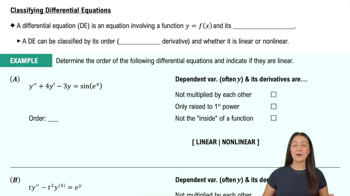
Classifying Differential Equations

Substitution Method for Bernoulli Equations

To solve a Bernoulli equation, use the substitution v = y^(1-n), which converts the nonlinear equation into a linear differential equation in terms of v. This allows the use of standard methods for linear ODEs.
Video consigliato:
07:33
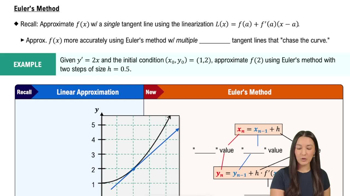
Euler's Method

Solving Linear First-Order Differential Equations

Once transformed, the equation becomes linear and can be solved using an integrating factor, μ(t) = e^(∫P(t)dt). Multiplying through by μ(t) simplifies the equation, enabling integration and solution for v(t), and then y(t).
Video consigliato:
06:06
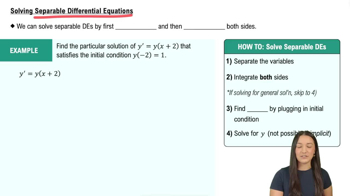
Solving Separable Differential Equations
Pratica correlata
Domanda del libro di testo

38–43. Equilibrium solutions A differential equation of the form y′(t)=f(y) is said to be autonomous (the function f depends only on y). The constant function y=y0 is an equilibrium solution of the equation provided f(y0)=0 (because then y'(t)=0 and the solution remains constant for all t). Note that equilibrium solutions correspond to horizontal lines in the direction field. Note also that for autonomous equations, the direction field is independent of t. Carry out the following analysis on the given equations.

c. Sketch the solution curve that corresponds to the initial condition y0=1. 


y′(t) = 6 - 2y

55
views
Domanda del libro di testo

52-56. In this section, several models are presented and the solution of the associated differential equation is given. Later in the chapter, we present methods for solving these differential equations.


(Use of Tech) Chemical rate equations The reaction of certain chemical compounds can be modeled using a differential equation of the form y'(t) = -kyⁿ(t), where y(t) is the concentration of the compound, for t ≥ 0, k > 0 is a constant that determines the speed of the reaction, and n is a positive integer called the order of the reaction. Assume the initial concentration of the compound is y(0) = y₀ > 0.


c. Let y₀ = 1 and k = 0.1. Graph the first-order and second-order solutions found in parts (a) and (b). Compare the two reactions. 

48
views
Domanda del libro di testo

Another second-order equation Consider the differential equation y''(t) + k²y(t) = 0, where k is a positive real number.

c. Give the general solution of the equation for arbitrary k > 0 and verify your conjecture.

101
views
Domanda del libro di testo

Cooling time Suppose an object with an initial temperature of T₀ > 0 is put in surroundings with an ambient temperature of A, where A < T₀/2. Let t₁/₂ be the time required for the object to cool to T₀/2.


c. Why is the condition A < T₀/2 needed?

49
views
Domanda del libro di testo

{Use of Tech} Fish harvesting A fish hatchery has 500 fish at t=0, when harvesting begins at a rate of b>0fish/year The fish population is modeled by the initial value problem y′(t)=0.01y−b,y(0)=500 where t is measured in years.


c. Graph the solution in the case that b=60fish/year. Describe the solution.

36
views
Domanda del libro di testo

[Use of Tech] Analysis of a separable equation Consider the differential equation yy'(t) = ½eᵗ + t and carry out the following analysis.

c. Graph the solutions in part (b) and describe their behavior as t increases. 

43
views