
Ch. 9 - Differential Equations
Briggs - Calculus: Early Transcendentals 3rd Edition
Briggs3rd EditionCalculus: Early TranscendentalsISBN: 9780136847243Non è quello che usi tu?Cambia libro di testo
Capitolo 9, Problema 9.3.47c

{Use of Tech} Free fall An object in free fall may be modeled by assuming the only forces at work are the gravitational force and air resistance. By Newton’s Second Law of Motion (mass end . acceleration = the sum of external forces), the velocity of the object satisfies the differential equation 


m · v'(t) = mg + f(v)
mass | acceleration | external forces


where f is a function that models the air resistance (assuming the positive direction is downward). One common assumption (often used for motion in air) is that f(v)=−kv^2, for t≥0, where k>0 is a drag coefficient.


c. Find the solution of this separable equation assuming v(0)=0 and 0<v²<g/a. 

Guida verificata passo dopo passo
1
Start with the given differential equation: \(m \cdot v'(t) = mg + f(v)\), where \(f(v) = -kv^2\). Substitute \(f(v)\) to get \(m \cdot v'(t) = mg - kv^2\).
Rewrite the equation to isolate \(v'(t)\): \(v'(t) = g - \frac{k}{m} v^2\). This is a separable differential equation.
Separate variables by writing \(\frac{dv}{dt} = g - \frac{k}{m} v^2\) as \(\frac{dv}{g - \frac{k}{m} v^2} = dt\).
Integrate both sides: integrate the left side with respect to \(v\) and the right side with respect to \(t\). The integral on the left involves a rational function of \(v^2\), which can be handled using a trigonometric substitution or recognizing it as a standard integral form.
Apply the initial condition \(v(0) = 0\) to solve for the constant of integration after performing the integration, and express \(v\) explicitly as a function of \(t\).

Risposta video verificata per un problema simile:

Questa soluzione video è stata consigliata dai nostri tutor come utile per risolvere questo problema.
Durata del video:
7m

Concetti chiave

Ecco i concetti essenziali che devi comprendere per rispondere correttamente alla domanda.

Newton's Second Law and Differential Equations

Newton's Second Law states that mass times acceleration equals the sum of external forces. In this problem, it leads to a differential equation relating velocity and time. Understanding how to translate physical laws into differential equations is essential for modeling motion under forces like gravity and air resistance.
Video consigliato:
10:44
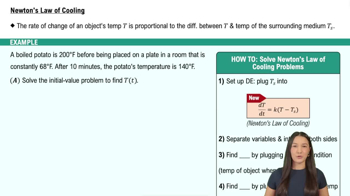
Newton's Law of Cooling

Separable Differential Equations

A separable differential equation can be written so that all terms involving the dependent variable are on one side and all terms involving the independent variable are on the other. This allows integration on both sides to find the solution. Recognizing and solving separable equations is key to finding velocity as a function of time here.
Video consigliato:
06:06
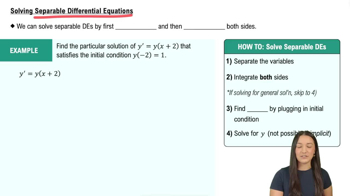
Solving Separable Differential Equations

Modeling Air Resistance as a Quadratic Drag Force

Air resistance is often modeled as a force proportional to the square of velocity, expressed as f(v) = -kv², where k > 0 is the drag coefficient. This nonlinear term affects the acceleration and velocity, making the differential equation nonlinear. Understanding this model helps in setting up and solving the equation for velocity under drag.
Video consigliato:
09:29
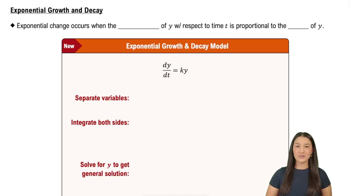
Exponential Growth & Decay
Pratica correlata
Domanda del libro di testo

46–48. Analyzing models The following models were discussed in Section 9.1 and reappear in later sections of this chapter. In each case, carry out the indicated analysis using direction fields.


Drug infusion The delivery of a drug (such as an antibiotic) through an intravenous line may be modeled by the differential equation m′(t)+km(t)=I, where m(t) is the mass of the drug in the blood at time t≥0, K is a constant that describes the rate at which the drug is absorbed, and I is the infusion rate. Let I=10mg/hr and k=0.05 hr^−1.

c. What is the equilibrium solution?

66
views
Domanda del libro di testo

Another second-order equation Consider the differential equation y''(t) + k²y(t) = 0, where k is a positive real number.

c. Give the general solution of the equation for arbitrary k > 0 and verify your conjecture.

101
views
Domanda del libro di testo

{Use of Tech} Fish harvesting A fish hatchery has 500 fish at t=0, when harvesting begins at a rate of b>0fish/year The fish population is modeled by the initial value problem y′(t)=0.01y−b,y(0)=500 where t is measured in years.


c. Graph the solution in the case that b=60fish/year. Describe the solution.

36
views
Domanda del libro di testo

17–20. Increasing and decreasing solutions Consider the following differential equations. A detailed direction field is not needed.


c. Which initial conditions y(0) = A lead to solutions that are increasing in time? Decreasing?


y'(t) = cos y for |y| ≤ π

37
views
Domanda del libro di testo

[Use of Tech] Analysis of a separable equation Consider the differential equation yy'(t) = ½eᵗ + t and carry out the following analysis.

c. Graph the solutions in part (b) and describe their behavior as t increases. 

43
views
Domanda del libro di testo

Direction field analysis Consider the first-order initial value problem y'(t)=ay+b,y(0)=A for t≥0 where a, b, and A are real numbers.

c. Draw a representative direction field in the case that a<0. Show that if A>−b/a, then the solution decreases for t≥0, and that if A<−b/a, then the solution increases for t≥0.

42
views