Ch. 9 - Differential Equations
Briggs - Calculus: Early Transcendentals 3rd Edition
Briggs3rd EditionCalculus: Early TranscendentalsISBN: 9780136847243Non è quello che usi tu?Cambia libro di testo
Capitolo 9, Problema 9.3.40a

{Use of Tech} Logistic equation for an epidemic When an infected person is introduced into a closed and otherwise healthy community, the number of people who contract the disease (in the absence of any intervention) may be modeled by the logistic equation
dP/dt=kP(1−P/A),P0=P_0,
where K is a positive infection rate, A is the number of people in the community, and P0 is the number of infected people at t=0. The model also assumes no recovery.
a. Find the solution of the initial value problem, for t≥0, in terms of K, A, and P0.

Guida verificata passo dopo passo
1
Recognize that the given differential equation is a logistic differential equation of the form \(\frac{dP}{dt} = kP\left(1 - \frac{P}{A}\right)\), where \(k\) and \(A\) are constants, and \(P(t)\) is the function to solve for with initial condition \(P(0) = P_0\).
Rewrite the equation to separate variables: \(\frac{dP}{P(1 - \frac{P}{A})} = k \, dt\). This allows us to integrate both sides with respect to their variables.
Simplify the left side by expressing the denominator as \(P\left(1 - \frac{P}{A}\right) = P \left(\frac{A - P}{A}\right) = \frac{P(A - P)}{A}\). Then, rewrite the integral as \(\int \frac{A}{P(A - P)} \, dP = \int k \, dt\).
Use partial fraction decomposition to break down \(\frac{A}{P(A - P)}\) into simpler fractions: \(\frac{A}{P(A - P)} = \frac{C}{P} + \frac{D}{A - P}\). Find constants \(C\) and \(D\) by equating numerators.
Integrate both sides: \(\int \left(\frac{C}{P} + \frac{D}{A - P}\right) dP = \int k \, dt\). After integration, solve for \(P(t)\) explicitly, applying the initial condition \(P(0) = P_0\) to find the constant of integration.

Risposta video verificata per un problema simile:

Questa soluzione video è stata consigliata dai nostri tutor come utile per risolvere questo problema.
Durata del video:
8m

Concetti chiave

Ecco i concetti essenziali che devi comprendere per rispondere correttamente alla domanda.

Logistic Differential Equation

The logistic differential equation models population growth with a carrying capacity, expressed as dP/dt = kP(1 - P/A). Here, P(t) is the population at time t, k is the growth rate, and A is the maximum population limit. It captures initial exponential growth that slows as P approaches A.
Video consigliato:
07:39
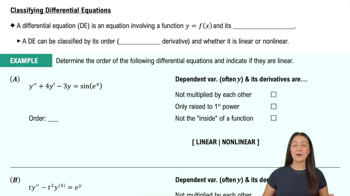
Classifying Differential Equations

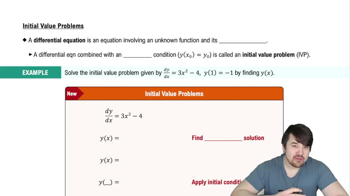
Initial Value Problem (IVP)

An initial value problem involves solving a differential equation with a given initial condition, such as P(0) = P0. This condition allows determination of the specific solution curve that fits the starting state of the system, ensuring a unique solution.
Video consigliato:
Percorso guidato
05:03
Initial Value Problems

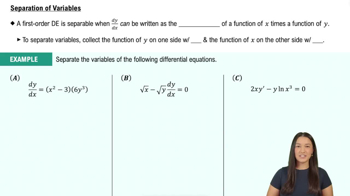
Separation of Variables Method

Separation of variables is a technique to solve differential equations by rewriting them so that all terms involving P are on one side and all terms involving t on the other. Integrating both sides then yields an implicit or explicit solution for P(t).
Video consigliato:
07:15
Separation of Variables
Pratica correlata
Domanda del libro di testo

Explain why or why not Determine whether the following statements are true and give an explanation or counterexample.

a. The differential equation y′+2y=t is first-order, linear, and separable.

47
views

Domanda del libro di testo

43–44. Motion in a gravitational field: An object is fired vertically upward with initial velocity v(0)=v₀ from initial position s(0)=s₀.

a. For the following values of v₀ and s₀, find the position and velocity functions for all times at which the object is above the ground (s = 0).

v₀ = 49 m/s, s₀ = 60 m

52
views
Domanda del libro di testo

29–32. {Use of Tech} Errors in Euler’s method Consider the following initial value problems.


a. Find the approximations to y(0.2) and y(0.4) using Euler’s method with time steps of Δt = 0.2, 0.1, 0.05, and 0.025.


y′(t) = y/2, y(0) = 2; y(t) = 2eᵗᐟ²

69
views
Domanda del libro di testo

42–43. Implicit solutions for separable equations For the following separable equations, carry out the indicated analysis.

a. Find the general solution of the equation.


e⁻ʸᐟ²y'(x) = 4x sin x² − x; y(0) = 0, y(0) = ln(1/4), y(√(π/2)) = 0


42
views
Domanda del libro di testo

38–43. Equilibrium solutions A differential equation of the form y′(t)=f(y) is said to be autonomous (the function f depends only on y). The constant function y=y0 is an equilibrium solution of the equation provided f(y0)=0 (because then y'(t)=0 and the solution remains constant for all t). Note that equilibrium solutions correspond to horizontal lines in the direction field. Note also that for autonomous equations, the direction field is independent of t. Carry out the following analysis on the given equations.

a. Find the equilibrium solutions. 


y′(t) = y(2 - y)

84
views
Domanda del libro di testo

27–30. Predator-prey models Consider the following pairs of differential equations that model a predator-prey system with populations x and y. In each case, carry out the following steps.

a. Identify which equation corresponds to the predator and which corresponds to the prey.


x′(t) = −3x + xy, y′(t) = 2y − xy

72
views