
Ch.12 - Parametric and Polar Curves
Briggs - Calculus: Early Transcendentals 3rd Edition
Briggs3rd EditionCalculus: Early TranscendentalsISBN: 9780136847243Non è quello che usi tu?Cambia libro di testo
Capitolo 12, Problema 12.3.33

33–40. Areas of regions Make a sketch of the region and its bounding curves. Find the area of the region.


The region inside the curve r = √(cos θ)

Guida verificata passo dopo passo
1
First, understand the curve given in polar coordinates: \(r = \sqrt{\cos \theta}\). Since \(r\) must be real, identify the domain of \(\theta\) where \(\cos \theta \geq 0\). This will help determine the bounds for integration.
Sketch the curve by plotting points for values of \(\theta\) within the domain found. Note that \(r\) is non-negative and depends on \(\cos \theta\), which is positive in the intervals \([-\frac{\pi}{2}, \frac{\pi}{2}]\) and \([\frac{3\pi}{2}, \frac{5\pi}{2}]\), but since \(r\) is defined as \(\sqrt{\cos \theta}\), focus on the principal interval where \(r\) is real and positive.
Recall the formula for the area enclosed by a polar curve between angles \(\alpha\) and \(\beta\) is \(A = \frac{1}{2} \int_{\alpha}^{\beta} r^2 \, d\theta\). Substitute \(r^2 = \cos \theta\) into this formula.
Set up the integral for the area as \(A = \frac{1}{2} \int_{-\frac{\pi}{2}}^{\frac{\pi}{2}} \cos \theta \, d\theta\), using the interval where \(r\) is real and positive.
Evaluate the integral by integrating \(\cos \theta\) over the interval, then multiply by \(\frac{1}{2}\). This will give the area of the region inside the curve.

Risposta video verificata per un problema simile:

Questa soluzione video è stata consigliata dai nostri tutor come utile per risolvere questo problema.
Durata del video:
3m

Concetti chiave

Ecco i concetti essenziali che devi comprendere per rispondere correttamente alla domanda.

Polar Coordinates and Curves

Polar coordinates represent points using a radius and an angle (r, θ). Curves defined in polar form, like r = √(cos θ), describe shapes based on these parameters. Understanding how to interpret and plot such curves is essential for visualizing the region whose area is to be found.
Video consigliato:
05:32
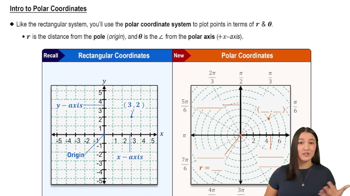
Intro to Polar Coordinates

Area Calculation in Polar Coordinates

The area enclosed by a polar curve r(θ) from θ = a to θ = b is given by the integral (1/2) ∫[a to b] (r(θ))^2 dθ. This formula accounts for the sector-like slices of the region, making it crucial for finding areas bounded by polar curves.
Video consigliato:
05:32
Intro to Polar Coordinates

Determining the Limits of Integration

To compute the area, one must identify the correct interval [a, b] for θ where the curve is defined and the region is enclosed. This often involves analyzing where r(θ) is real and non-negative, and where the curve completes a full loop or returns to the starting point.
Video consigliato:
05:50
One-Sided Limits