Ch.12 - Parametric and Polar Curves
Briggs - Calculus: Early Transcendentals 3rd Edition
Briggs3rd EditionCalculus: Early TranscendentalsISBN: 9780136847243Non è quello che usi tu?Cambia libro di testo
Capitolo 12, Problema 12.3.39

33–40. Areas of regions Make a sketch of the region and its bounding curves. Find the area of the region.


The region inside one leaf of r = cos 3θ

Guida verificata passo dopo passo
1
First, understand the curve given: \(r = \cos 3\theta\) is a rose curve with 3 petals because the coefficient of \(\theta\) inside the cosine is 3. Each petal corresponds to a range of \(\theta\) where \(r\) is positive.
To find the area of one leaf (one petal), identify the interval of \(\theta\) that traces out exactly one petal. Since the rose has 3 petals evenly spaced over \(0\) to \(2\pi\), one petal corresponds to an interval of length \(\frac{2\pi}{3}\). Typically, one petal is traced from \(\theta = -\frac{\pi}{6}\) to \(\theta = \frac{\pi}{6}\) or from \(0\) to \(\frac{\pi}{3}\) depending on the petal chosen.
Recall the formula for the area enclosed by a polar curve between angles \(\alpha\) and \(\beta\) is: \(\text{Area} = \frac{1}{2} \int_{\alpha}^{\beta} r^2 \, d\theta\)
Substitute \(r = \cos 3\theta\) into the formula to get: \(\text{Area} = \frac{1}{2} \int_{\alpha}^{\beta} (\cos 3\theta)^2 \, d\theta\)
Evaluate the integral by using the identity \(\cos^2 x = \frac{1 + \cos 2x}{2}\) to simplify the integrand before integrating. Then compute the definite integral over the chosen interval for one petal.

Risposta video verificata per un problema simile:

Questa soluzione video è stata consigliata dai nostri tutor come utile per risolvere questo problema.
Durata del video:
3m

Concetti chiave

Ecco i concetti essenziali che devi comprendere per rispondere correttamente alla domanda.

Polar Coordinates and Graphing

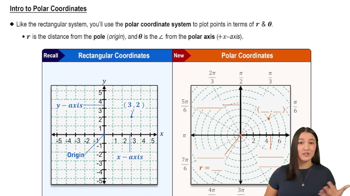
Polar coordinates represent points using a radius and an angle, making it easier to describe curves like r = cos 3θ. Understanding how to sketch such curves helps visualize the region whose area is to be found, especially when the curve forms multiple 'leaves' or petals.
Video consigliato:
05:32
Intro to Polar Coordinates

Area Calculation in Polar Coordinates

The area enclosed by a polar curve between two angles is found using the integral formula A = (1/2) ∫ (r(θ))^2 dθ. This formula accounts for the sector-like shape of regions in polar graphs, allowing precise calculation of areas bounded by curves like r = cos 3θ.
Video consigliato:
05:32
Intro to Polar Coordinates

Determining Limits of Integration for One Leaf

To find the area of one leaf of r = cos 3θ, it is essential to identify the correct interval of θ where the leaf exists. This involves solving r = 0 to find boundary angles and integrating over the range that traces exactly one petal without overlap.
Video consigliato:
05:50
One-Sided Limits