Ch.12 - Parametric and Polar Curves
Briggs - Calculus: Early Transcendentals 3rd Edition
Briggs3rd EditionCalculus: Early TranscendentalsISBN: 9780136847243Non è quello che usi tu?Cambia libro di testo
Capitolo 12, Problema 12.4.49

39–50. Equations of ellipses and hyperbolas Find an equation of the following ellipses and hyperbolas, assuming the center is at the origin. 
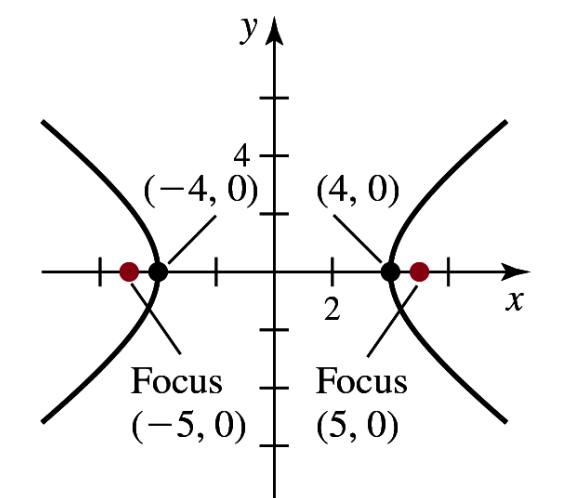
Graph of a hyperbola centered at the origin with labeled vertices at (±4, 0) and foci at (±5, 0).

Guida verificata passo dopo passo
1
Identify the type of conic section: Since the graph shows two branches opening left and right with vertices at (±4, 0) and foci at (±5, 0), this is a hyperbola centered at the origin with a horizontal transverse axis.
Recall the standard form of the equation of a hyperbola centered at the origin with a horizontal transverse axis: \(\frac{x^2}{a^2} - \frac{y^2}{b^2} = 1\).
Determine the value of \(a\): The vertices are at (±4, 0), so \(a = 4\), which means \(a^2 = 16\).
Determine the value of \(c\): The foci are at (±5, 0), so \(c = 5\), which means \(c^2 = 25\).
Use the relationship between \(a\), \(b\), and \(c\) for hyperbolas: \(c^2 = a^2 + b^2\). Substitute the known values to solve for \(b^2\): \(25 = 16 + b^2\), then solve for \(b^2\).

Risposta video verificata per un problema simile:

Questa soluzione video è stata consigliata dai nostri tutor come utile per risolvere questo problema.
Durata del video:
3m

Concetti chiave

Ecco i concetti essenziali che devi comprendere per rispondere correttamente alla domanda.

Standard Equation of a Hyperbola Centered at the Origin

A hyperbola centered at the origin with a horizontal transverse axis has the equation \( \frac{x^2}{a^2} - \frac{y^2}{b^2} = 1 \). Here, \(a\) is the distance from the center to each vertex along the x-axis, and \(b\) relates to the distance along the conjugate axis. Understanding this form is essential to write the equation from given vertices and foci.
Video consigliato:
Percorso guidato
5:59
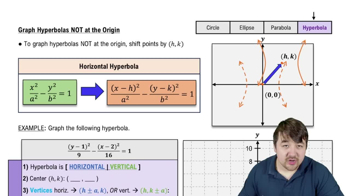
Graph Hyperbolas NOT at the Origin

Relationship Between Vertices, Foci, and Parameters \(a\), \(b\), and \(c\)

For hyperbolas, \(a\) is the distance from the center to each vertex, and \(c\) is the distance to each focus. These satisfy the equation \( c^2 = a^2 + b^2 \). Knowing the coordinates of vertices and foci allows calculation of \(a\), \(c\), and subsequently \(b\), which are needed to form the hyperbola's equation.
Video consigliato:
Percorso guidato
5:22
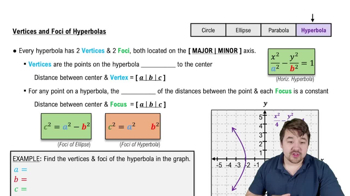
Foci and Vertices of Hyperbolas

Graph Interpretation and Coordinate Geometry

Interpreting the graph involves identifying key points such as vertices and foci and their coordinates. This helps in determining the values of \(a\) and \(c\) directly from the graph. Accurate reading of these points is crucial for applying the hyperbola formulas correctly.
Video consigliato:
05:32
Intro to Polar Coordinates