Ch.12 - Parametric and Polar Curves
Briggs - Calculus: Early Transcendentals 3rd Edition
Briggs3rd EditionCalculus: Early TranscendentalsISBN: 9780136847243Non è quello che usi tu?Cambia libro di testo
Capitolo 12, Problema 12.2.82

80–83. Equations of circles Use the results of Exercises 78–79 to describe and graph the following circles.


r² - 8r cos(θ - π/2) = 9

Guida verificata passo dopo passo
1
Recognize that the given equation is in polar form: \(r^{2} - 8r \cos(\theta - \frac{\pi}{2}) = 9\). Our goal is to rewrite this in a more recognizable form, such as the standard form of a circle in Cartesian coordinates.
Recall the polar to Cartesian coordinate conversions: \(x = r \cos \theta\) and \(y = r \sin \theta\). Also, note that \(\cos(\theta - \alpha) = \cos \theta \cos \alpha + \sin \theta \sin \alpha\).
Apply the cosine difference identity to expand \(\cos(\theta - \frac{\pi}{2})\): \(\cos\left(\theta - \frac{\pi}{2}\right) = \cos \theta \cos \frac{\pi}{2} + \sin \theta \sin \frac{\pi}{2} = 0 + \sin \theta = \sin \theta\).
Substitute this back into the original equation to get: \(r^{2} - 8r \sin \theta = 9\). Then, rewrite \(r^{2}\) as \(x^{2} + y^{2}\) and \(r \sin \theta\) as \(y\), giving: \(x^{2} + y^{2} - 8y = 9\).
Complete the square for the \(y\) terms to write the equation in standard circle form: \(x^{2} + (y^{2} - 8y + 16) = 9 + 16\) which simplifies to: \(x^{2} + (y - 4)^{2} = 25\). This represents a circle centered at \((0, 4)\) with radius \(5\).

Risposta video verificata per un problema simile:

Questa soluzione video è stata consigliata dai nostri tutor come utile per risolvere questo problema.
Durata del video:
3m

Concetti chiave

Ecco i concetti essenziali che devi comprendere per rispondere correttamente alla domanda.

Polar Coordinates and Equations

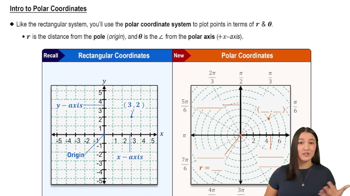
Polar coordinates represent points using a radius and an angle (r, θ) instead of Cartesian coordinates (x, y). Understanding how to interpret and manipulate equations in polar form is essential for analyzing curves like circles defined by r and θ.
Video consigliato:
05:32
Intro to Polar Coordinates

Conversion Between Polar and Cartesian Forms

Converting polar equations to Cartesian form (using x = r cos θ and y = r sin θ) helps visualize and graph curves. This conversion is crucial for recognizing standard geometric shapes, such as circles, from polar equations.
Video consigliato:
05:32
Intro to Polar Coordinates

Standard Equation of a Circle in Polar Coordinates

A circle in polar coordinates can often be expressed as r = 2a cos(θ - α) + b or similar forms. Recognizing these forms and relating them to the circle's center and radius aids in graphing and understanding the geometric properties of the circle.
Video consigliato:
05:32
Intro to Polar Coordinates