Ch.12 - Parametric and Polar Curves
Briggs - Calculus: Early Transcendentals 3rd Edition
Briggs3rd EditionCalculus: Early TranscendentalsISBN: 9780136847243Non è quello che usi tu?Cambia libro di testo
Capitolo 12, Problema 12.1.84

81–88. Arc length Find the arc length of the following curves on the given interval.


x = eᵗ sin t, y = eᵗ cos t; 0 ≤ t ≤ 2π

Guida verificata passo dopo passo
1
Recall the formula for the arc length of a parametric curve given by \(x = x(t)\) and \(y = y(t)\) over the interval \(a \leq t \leq b\): \[L = \int_a^b \sqrt{\left(\frac{dx}{dt}\right)^2 + \left(\frac{dy}{dt}\right)^2} \, dt\]
Find the derivatives \(\frac{dx}{dt}\) and \(\frac{dy}{dt}\) for the given functions: \[x = e^t \sin t, \quad y = e^t \cos t\] Use the product rule for differentiation since both \(x\) and \(y\) are products of \(e^t\) and trigonometric functions.
Compute \(\frac{dx}{dt}\): \[\frac{dx}{dt} = \frac{d}{dt}(e^t \sin t) = e^t \sin t + e^t \cos t\] Compute \(\frac{dy}{dt}\): \[\frac{dy}{dt} = \frac{d}{dt}(e^t \cos t) = e^t \cos t - e^t \sin t\]
Substitute \(\frac{dx}{dt}\) and \(\frac{dy}{dt}\) into the arc length formula under the square root: \[\sqrt{(e^t \sin t + e^t \cos t)^2 + (e^t \cos t - e^t \sin t)^2}\] Simplify the expression inside the square root by expanding and combining like terms.
Set up the integral for the arc length over the interval \(0 \leq t \leq 2\pi\): \[L = \int_0^{2\pi} \sqrt{(\frac{dx}{dt})^2 + (\frac{dy}{dt})^2} \, dt\] After simplification, evaluate or express the integral in a form ready for calculation.

Risposta video verificata per un problema simile:

Questa soluzione video è stata consigliata dai nostri tutor come utile per risolvere questo problema.
Durata del video:
8m

Concetti chiave

Ecco i concetti essenziali che devi comprendere per rispondere correttamente alla domanda.

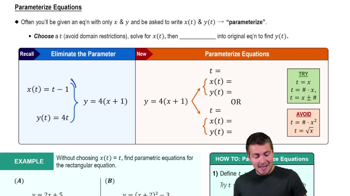
Parametric Equations

Parametric equations express the coordinates of a curve as functions of a parameter, often denoted t. Instead of y as a function of x, both x and y depend on t, allowing the description of more complex curves. Understanding how to work with parametric forms is essential for calculating properties like arc length.
Video consigliato:
08:02
Parameterizing Equations

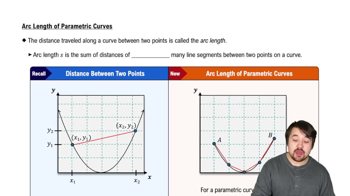
Arc Length Formula for Parametric Curves

The arc length of a curve defined parametrically by x(t) and y(t) from t = a to t = b is given by the integral of the square root of (dx/dt)² + (dy/dt)² dt. This formula sums the infinitesimal distances along the curve, providing the total length over the interval.
Video consigliato:
Percorso guidato
06:29
Arc Length of Parametric Curves

Differentiation of Exponential and Trigonometric Functions

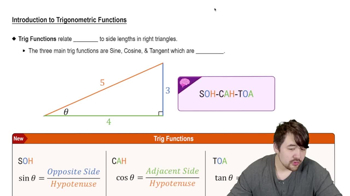
Calculating dx/dt and dy/dt requires differentiating functions involving products of exponentials and trigonometric terms. Mastery of the product rule and derivatives of e^t, sin t, and cos t is necessary to correctly find these derivatives and proceed with the arc length calculation.
Video consigliato:
Percorso guidato
6:04
Introduction to Trigonometric Functions
Pratica correlata
Domanda del libro di testo

Find the area of the region bounded by the astroid x = cos³ t, y = sin³ t, for 0 ≤ t ≤ 2π

87
views

Domanda del libro di testo

{Use of Tech} Implicit function graph Explain and carry out a method for graphing the curve x = 1 + cos² y − sin² y using parametric equations and a graphing utility.

24
views
Domanda del libro di testo

37–52. Curves to parametric equations Find parametric equations for the following curves. Include an interval for the parameter values. Answers are not unique.


A circle centered at the origin with radius 4, generated counterclockwise

54
views
Domanda del libro di testo

Circles in general Show that the polar equation

r² - 2r r₀ cos(θ - θ₀) = R² - r₀²

describes a circle of radius R whose center has polar coordinates (r₀, θ₀)

76
views
Domanda del libro di testo

53–56. Circular motion Find parametric equations that describe the circular path of the following objects. For Exercises 53–55, assume (x, y) denotes the position of the object relative to the origin at the center of the circle. Use the units of time specified in the problem. There are many ways to describe any circle.


The tip of the 15-inch second hand of a clock completes one revolution in 60 seconds.

66
views
Domanda del libro di testo

37–52. Curves to parametric equations Find parametric equations for the following curves. Include an interval for the parameter values. Answers are not unique.


The line that passes through the points P(1, 1) and Q(3, 5), oriented in the direction of increasing x

42
views