
Ch.12 - Parametric and Polar Curves
Briggs - Calculus: Early Transcendentals 3rd Edition
Briggs3rd EditionCalculus: Early TranscendentalsISBN: 9780136847243Non è quello che usi tu?Cambia libro di testo
Capitolo 12, Problema 12.2.11

9–13. Graph the points with the following polar coordinates. Give two alternative representations of the points in polar coordinates.


(-1, -π/3)

Guida verificata passo dopo passo
1
Recall that a point in polar coordinates is given as \((r, \theta)\), where \(r\) is the radius (distance from the origin) and \(\theta\) is the angle measured from the positive x-axis.
Given the point \((-1, -\frac{\pi}{3})\), note that the radius \(r\) is negative. A negative radius means the point is located in the direction opposite to the angle \(\theta\).
To find an alternative representation, convert the point by changing the radius to positive and adjusting the angle by adding \(\pi\) (180 degrees) to the original angle: \((r, \theta) = (-1, -\frac{\pi}{3})\) becomes \((1, -\frac{\pi}{3} + \pi)\).
Another alternative is to add \(2\pi\) to the angle to keep the radius negative but express the angle in a positive coterminal form: \((-1, -\frac{\pi}{3} + 2\pi)\).
Finally, you can also express the point with a positive radius and an angle coterminal to the one found in step 3 by adding or subtracting multiples of \(2\pi\) to the angle, for example \((1, -\frac{\pi}{3} + \pi + 2\pi)\).

Risposta video verificata per un problema simile:

Questa soluzione video è stata consigliata dai nostri tutor come utile per risolvere questo problema.
Durata del video:
1m

Concetti chiave

Ecco i concetti essenziali che devi comprendere per rispondere correttamente alla domanda.

Polar Coordinates System

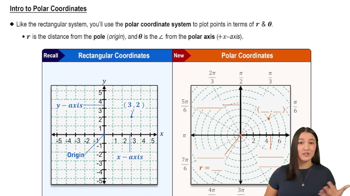
The polar coordinate system represents points in a plane using a radius and an angle, denoted as (r, θ). The radius r is the distance from the origin, and θ is the angle measured from the positive x-axis. Understanding how to plot points using these two values is fundamental for graphing in polar coordinates.
Video consigliato:
05:32
Intro to Polar Coordinates

Negative Radius in Polar Coordinates

A negative radius means the point is plotted in the direction opposite to the angle θ. For example, (−r, θ) is equivalent to (r, θ + π), reflecting the point across the origin. Recognizing this helps in converting and graphing points with negative radii correctly.
Video consigliato:
05:32
Intro to Polar Coordinates

Alternative Representations of Polar Coordinates

Polar points can have multiple equivalent representations by adding or subtracting 2π to the angle or changing the sign of the radius while adjusting the angle by π. This flexibility allows expressing the same point in different forms, which is useful for understanding and comparing polar coordinates.
Video consigliato:
05:32
Intro to Polar Coordinates
Pratica correlata
Domanda del libro di testo

85–87. Grazing goat problems Consider the following sequence of problems related to grazing goats tied to a rope. (See the Guided Project Grazing goat problems.)


A circular corral of unit radius is enclosed by a fence. A goat is outside the corral and tied to the fence with a rope of length 0≤a ≤ π (see figure). What is the area of the region (outside the corral) that the goat can reach?


47
views
Domanda del libro di testo

Subtle symmetry Without using a graphing utility, determine the symmetries (if any) of the curve r=4-sin (θ/2)

59
views
Domanda del libro di testo

37–48. Polar-to-Cartesian coordinates Convert the following equations to Cartesian coordinates. Describe the resulting curve.


r = sin θ sec² θ

45
views
Domanda del libro di testo

63–74. Arc length of polar curves Find the length of the following polar curves.


The spiral r = θ², for 0 ≤ θ ≤ 2π

66
views
Domanda del libro di testo

23–24. Radar Airplanes are equipped with transponders that allow air traffic controllers to see their locations on radar screens. Radar gives the distance of the plane from the radar station (located at the origin) and the angular position of the plane, typically measured in degrees clockwise from north.

A plane is 50 miles from a radar station at an angle of 10 dgeree clockwise from north. Find polar coordinates for the location of the plane.

53
views
Domanda del libro di testo

49–52. Cartesian-to-polar coordinates Convert the following equations to polar coordinates.


(x - 1)² + y² = 1

71
views