Ch.12 - Parametric and Polar Curves
Briggs - Calculus: Early Transcendentals 3rd Edition
Briggs3rd EditionCalculus: Early TranscendentalsISBN: 9780136847243Non è quello che usi tu?Cambia libro di testo
Capitolo 12, Problema 12.3.1

Express the polar equation r=f(θ) in parametric form in Cartesian coordinates, where θ is the parameter.

Guida verificata passo dopo passo
1
Recall the relationship between polar and Cartesian coordinates: \(x = r \cos(\theta)\) and \(y = r \sin(\theta)\), where \(r\) is the radius and \(\theta\) is the angle parameter.
Given the polar equation \(r = f(\theta)\), substitute \(r\) into the Cartesian coordinate formulas to express \(x\) and \(y\) in terms of \(\theta\).
Write the parametric equations as \(x(\theta) = f(\theta) \cdot \cos(\theta)\) and \(y(\theta) = f(\theta) \cdot \sin(\theta)\).
Note that \(\theta\) serves as the parameter that varies, typically within an interval such as \([0, 2\pi]\), to trace the curve in the Cartesian plane.
Thus, the polar equation \(r = f(\theta)\) is expressed in parametric form as \(\left(x(\theta), y(\theta)\right) = \left(f(\theta) \cos(\theta), f(\theta) \sin(\theta)\right)\).

Risposta video verificata per un problema simile:

Questa soluzione video è stata consigliata dai nostri tutor come utile per risolvere questo problema.
Durata del video:
1m

Concetti chiave

Ecco i concetti essenziali che devi comprendere per rispondere correttamente alla domanda.

Polar Coordinates

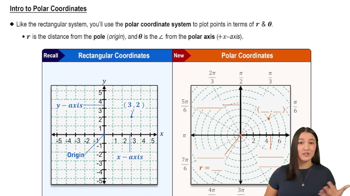
Polar coordinates represent points in a plane using a radius and an angle (r, θ) from the origin. The radius r is the distance from the origin, and θ is the angle measured from the positive x-axis. Understanding this system is essential to convert between polar and Cartesian forms.
Video consigliato:
05:32
Intro to Polar Coordinates

Parametric Equations

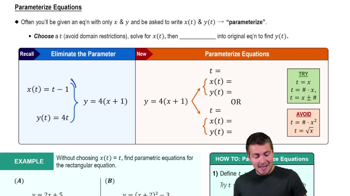
Parametric equations express coordinates as functions of a parameter, often denoted t or θ. Instead of y as a function of x, both x and y are defined separately in terms of the parameter, allowing more flexible representations of curves, including those defined in polar form.
Video consigliato:
08:02
Parameterizing Equations

Conversion from Polar to Cartesian Coordinates

To convert polar equations to Cartesian form, use the relationships x = r cos(θ) and y = r sin(θ). When r is given as a function of θ, substituting r = f(θ) into these formulas yields parametric equations x(θ) and y(θ) in Cartesian coordinates.
Video consigliato:
05:32
Intro to Polar Coordinates