Ch.12 - Parametric and Polar Curves
Briggs - Calculus: Early Transcendentals 3rd Edition
Briggs3rd EditionCalculus: Early TranscendentalsISBN: 9780136847243Non è quello che usi tu?Cambia libro di testo
Capitolo 12, Problema 12.1.7

Find the slope of the parametric curve x=−2t ³ +1, y=3t ², for −∞<t<∞, at the point corresponding to t=2. 

Guida verificata passo dopo passo
1
Identify the parametric equations given: \(x = -2t^{3} + 1\) and \(y = 3t^{2}\).
Recall that the slope of the parametric curve at a given \(t\) is found by computing \(\frac{dy}{dx} = \frac{\frac{dy}{dt}}{\frac{dx}{dt}}\).
Find the derivative of \(x\) with respect to \(t\): \(\frac{dx}{dt} = \frac{d}{dt}(-2t^{3} + 1) = -6t^{2}\).
Find the derivative of \(y\) with respect to \(t\): \(\frac{dy}{dt} = \frac{d}{dt}(3t^{2}) = 6t\).
Evaluate \(\frac{dy}{dx}\) at \(t=2\) by substituting into the derivatives: \(\frac{dy}{dx} = \frac{6 \times 2}{-6 \times (2)^{2}}\).

Risposta video verificata per un problema simile:

Questa soluzione video è stata consigliata dai nostri tutor come utile per risolvere questo problema.
Durata del video:
1m

Concetti chiave

Ecco i concetti essenziali che devi comprendere per rispondere correttamente alla domanda.

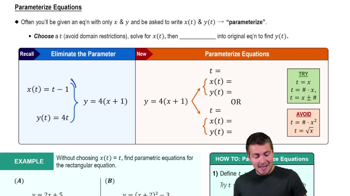
Parametric Equations

Parametric equations express the coordinates of points on a curve as functions of a parameter, usually denoted t. Instead of y as a function of x, both x and y depend on t, allowing the description of more complex curves and motions.
Video consigliato:
08:02
Parameterizing Equations

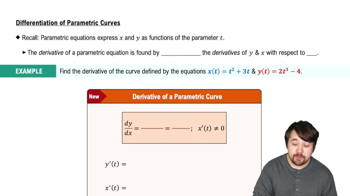
Derivative of Parametric Curves

To find the slope of a parametric curve at a given parameter t, compute dx/dt and dy/dt, then find dy/dx by dividing dy/dt by dx/dt. This gives the instantaneous rate of change of y with respect to x at that point.
Video consigliato:
Percorso guidato
06:49
Differentiation of Parametric Curves

Evaluating Derivatives at a Specific Parameter

After finding the general expression for dy/dx in terms of t, substitute the given value of t to find the slope at that specific point on the curve. This step provides the exact slope corresponding to the parameter value.
Video consigliato:
05:59
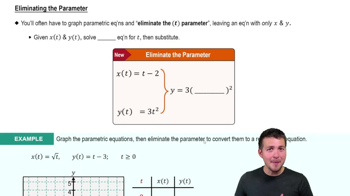
Eliminating the Parameter
Pratica correlata
Domanda del libro di testo

Multiple descriptions Which of the following parametric equations describe the same curve?

a. x = 2t², y = 4 + t; -4 ≤ t ≤ 4

b. x = 2t⁴, y = 4 + t²; -2 ≤ t ≤ 2

c. x = 2t^(2/3), y = 4 + t^(1/3); -64 ≤ t ≤ 64

44
views

Domanda del libro di testo

15–30. Working with parametric equations Consider the following parametric equations.

a. Eliminate the parameter to obtain an equation in x and y.

b. Describe the curve and indicate the positive orientation.


x = cos t, y = 1 + sin t; 0 ≤ t ≤ 2π

61
views
Domanda del libro di testo

69–72. Tangent lines Find an equation of the line tangent to the following curves at the given point.

x² = -6y; (-6, -6)

54
views
Domanda del libro di testo

37–52. Curves to parametric equations Find parametric equations for the following curves. Include an interval for the parameter values. Answers are not unique.


The segment of the parabola y=2x ²−4, where −1≤x≤5

61
views
Domanda del libro di testo

93–94. Parametric equations of ellipses Find parametric equations (not unique) of the following ellipses (see Exercises 91–92). Graph the ellipse and find a description in terms of x and y.


An ellipse centered at (-2, -3) with major and minor axes of lengths 30 and 20, parallel to the x- and y-axes, respectively, generated counterclockwise (Hint: Shift the parametric equations.)

160
views
Domanda del libro di testo

37–52. Curves to parametric equations Find parametric equations for the following curves. Include an interval for the parameter values. Answers are not unique.


The horizontal line segment starting at P(8, 2) and ending at Q(−2, 2)

29
views