Ch.12 - Parametric and Polar Curves
Briggs - Calculus: Early Transcendentals 3rd Edition
Briggs3rd EditionCalculus: Early TranscendentalsISBN: 9780136847243Non è quello che usi tu?Cambia libro di testo
Capitolo 12, Problema 12.R.35

Polar conversion Write the equation r ² +r(2sinθ−6cosθ)=0 in Cartesian coordinates and identify the corresponding curve.

Guida verificata passo dopo passo
1
Start with the given polar equation: \(r^{2} + r(2\sin\theta - 6\cos\theta) = 0\).
Recall the relationships between polar and Cartesian coordinates: \(x = r\cos\theta\), \(y = r\sin\theta\), and \(r^{2} = x^{2} + y^{2}\).
Rewrite each term in the equation using these relationships: replace \(r^{2}\) with \(x^{2} + y^{2}\), replace \(r\sin\theta\) with \(y\), and replace \(r\cos\theta\) with \(x\).
Substitute these into the equation to get: \((x^{2} + y^{2}) + (2y - 6x) = 0\).
Simplify and rearrange the equation to standard Cartesian form, then analyze the resulting equation to identify the type of curve it represents (such as a circle, ellipse, parabola, or hyperbola).

Risposta video verificata per un problema simile:

Questa soluzione video è stata consigliata dai nostri tutor come utile per risolvere questo problema.
Durata del video:
3m

Concetti chiave

Ecco i concetti essenziali che devi comprendere per rispondere correttamente alla domanda.

Polar to Cartesian Coordinate Conversion

This involves translating equations from polar form (r, θ) to Cartesian form (x, y) using the relationships x = r cos θ and y = r sin θ. Understanding these conversions allows one to rewrite polar equations in terms of x and y for easier analysis.
Video consigliato:
05:32
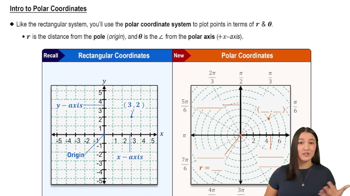
Intro to Polar Coordinates

Algebraic Manipulation of Polar Equations

Rearranging and simplifying polar equations often requires substituting r and trigonometric terms with Cartesian equivalents and then algebraically manipulating the resulting expressions. This step is crucial to express the equation in a recognizable Cartesian form.
Video consigliato:
6:50
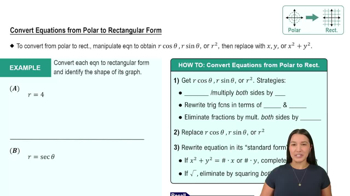
Convert Equations from Polar to Rectangular

Identification of Conic Sections

Once the equation is in Cartesian form, recognizing the type of curve (circle, ellipse, parabola, or hyperbola) involves comparing it to standard conic section equations. This helps in understanding the geometric nature of the curve represented by the original polar equation.
Video consigliato:
Percorso guidato
5:33
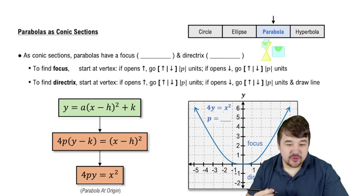
Parabolas as Conic Sections