39–50. Equations of ellipses and hyperbolas Find an equation of the following ellipses and hyperbolas, assuming the center is at the origin.
Ch.12 - Parametric and Polar Curves
Briggs3rd EditionCalculus: Early TranscendentalsISBN: 9780136847243Non è quello che usi tu?Cambia libro di testo
Capitolo 12, Problema 12.3.22
Tangent line at the origin Find the polar equation of the line tangent to the polar curve r=4cosθ at the origin. Explain why the slope of this line is undefined.
Guida verificata passo dopo passo1
Recall that the polar curve is given by \(r = 4 \cos \theta\). The point at the origin corresponds to \(r = 0\). Find the values of \(\theta\) where \(r = 0\) by solving \(4 \cos \theta = 0\).
Identify the points on the curve where it passes through the origin. These occur at the values of \(\theta\) found in the previous step. For each such \(\theta\), the curve passes through the origin \((r=0)\).
To find the slope of the tangent line in Cartesian coordinates, convert the polar coordinates to Cartesian using \(x = r \cos \theta\) and \(y = r \sin \theta\). Then express \(y\) as a function of \(x\) implicitly or find \(\frac{dy}{dx}\) using the chain rule and derivatives with respect to \(\theta\).
Use the formula for the slope of the tangent line to a polar curve: \(\frac{dy}{dx} = \frac{\frac{dr}{d\theta} \sin \theta + r \cos \theta}{\frac{dr}{d\theta} \cos \theta - r \sin \theta}\). Compute \(\frac{dr}{d\theta}\) and substitute \(r\), \(\theta\), and \(\frac{dr}{d\theta}\) at the point where \(r=0\).
Evaluate the slope at the origin. If the denominator of \(\frac{dy}{dx}\) is zero while the numerator is nonzero, the slope is undefined, indicating a vertical tangent line. This explains why the slope of the tangent line at the origin is undefined.

Risposta video verificata per un problema simile:
Questa soluzione video è stata consigliata dai nostri tutor come utile per risolvere questo problema.
Durata del video:
3mConcetti chiave
Ecco i concetti essenziali che devi comprendere per rispondere correttamente alla domanda.
Polar Coordinates and Polar Curves
Polar coordinates represent points using a radius and an angle (r, θ) from the origin. Polar curves are equations relating r and θ, describing shapes in the plane. Understanding how to interpret and plot these curves is essential for analyzing their properties, such as tangents.
Video consigliato:
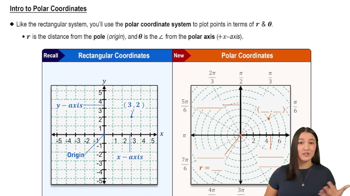
Intro to Polar Coordinates
Tangent Lines in Polar Coordinates
The tangent line to a polar curve at a point can be found by converting the curve to Cartesian coordinates or by using the derivative dr/dθ. The slope of the tangent line is given by dy/dx, which can be expressed in terms of r, θ, and dr/dθ. This helps identify the direction and slope of the tangent line at specific points.
Video consigliato:
Intro to Polar Coordinates
Undefined Slope and Vertical Tangents
A slope is undefined when the tangent line is vertical, meaning the change in x is zero while y changes. In polar curves, this occurs when the derivative dy/dx approaches infinity or is not defined. Recognizing when the slope is undefined explains the nature of the tangent line, especially at points like the origin.
Video consigliato:
Percorso guidato
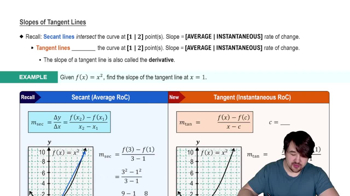
Slopes of Tangent Lines
Pratica correlata
Domanda del libro di testo
92
views
Domanda del libro di testo
What is the polar equation of the horizontal line y = 5?
85
views
Domanda del libro di testo
15–30. Working with parametric equations Consider the following parametric equations.
a. Eliminate the parameter to obtain an equation in x and y.
b. Describe the curve and indicate the positive orientation.
x = r − 1, y = r³; −4 ≤ r ≤ 4
50
views
Domanda del libro di testo
15–22. Sets in polar coordinates Sketch the following sets of points.
2 ≤ r ≤ 8
52
views
Domanda del libro di testo
31–36. Eliminating the parameter Eliminate the parameter to express the following parametric equations as a single equation in x and y.
x=2 sin 8t, y=2 cos 8t
92
views
Domanda del libro di testo
37–48. Polar-to-Cartesian coordinates Convert the following equations to Cartesian coordinates. Describe the resulting curve.
r = 6 cos θ + 8 sin θ
75
views