Ch. 1 - Functions
Hass - Thomas' Calculus 15th Edition
Hass15th EditionThomas' CalculusISBN: 9780137616077Non è quello che usi tu?Cambia libro di testo
Capitolo 1, Problema 1.2.13d

Composition of Functions


Copy and complete the following table.


d. <IMAGE>

Guida verificata passo dopo passo
1
Understand the concept of composition of functions: If you have two functions, f(x) and g(x), the composition of these functions is denoted as (f ∘ g)(x) = f(g(x)). This means you first apply g to x, and then apply f to the result of g(x).
Identify the functions involved in the problem. Let's assume the table provides specific functions f(x) and g(x) for different values of x. You will need to use these functions to find the composition for each given x value.
For each x value in the table, calculate g(x) first. This involves substituting the x value into the function g(x) to find the output.
Once you have g(x), substitute this result into the function f(x) to find f(g(x)). This is the composition of the functions for the given x value.
Repeat the process for each x value provided in the table to complete it. Ensure you carefully follow the order of operations and substitution to accurately find the composition for each entry.

Risposta video verificata per un problema simile:

Questa soluzione video è stata consigliata dai nostri tutor come utile per risolvere questo problema.
Durata del video:
2m

Concetti chiave

Ecco i concetti essenziali che devi comprendere per rispondere correttamente alla domanda.

Composition of Functions

The composition of functions involves combining two functions to create a new function. If you have two functions, f(x) and g(x), the composition is denoted as (f ∘ g)(x) = f(g(x)). This means you first apply g to x, and then apply f to the result of g. Understanding this concept is crucial for solving problems that require evaluating or manipulating functions in calculus.
Video consigliato:
3:48
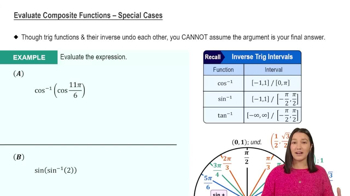
Evaluate Composite Functions - Special Cases

Function Notation

Function notation is a way to represent functions and their operations clearly. It typically uses letters like f, g, and h to denote functions, with the input variable in parentheses. For example, f(x) indicates the output of function f when the input is x. Mastery of function notation is essential for working with compositions, as it helps in tracking inputs and outputs through multiple functions.
Video consigliato:

Domain and Range

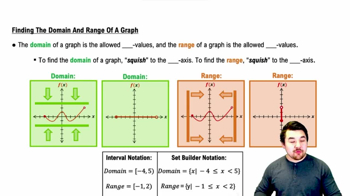
The domain of a function is the set of all possible input values (x-values) that the function can accept, while the range is the set of all possible output values (y-values) that the function can produce. When composing functions, it is important to consider the domain of the inner function and how it affects the overall composition. This ensures that the composition is valid and that all outputs are defined.
Video consigliato:
Percorso guidato
5:10
Finding the Domain and Range of a Graph