Ch. 1 - Functions
Hass - Thomas' Calculus 15th Edition
Hass15th EditionThomas' CalculusISBN: 9780137616077Non è quello che usi tu?Cambia libro di testo
Capitolo 1, Problema 1.20

In Exercises 19–32, find the (a) domain and (b) range.
____
𝔂 = -2 + √1 - x

Guida verificata passo dopo passo
1
Step 1: Identify the expression inside the square root, which is '1 - x'. The square root function is defined only for non-negative values, so set up the inequality 1 - x ≥ 0.
Step 2: Solve the inequality 1 - x ≥ 0 to find the domain of the function. Rearrange the inequality to find the values of x that satisfy it.
Step 3: The domain of the function is the set of x-values for which the expression inside the square root is non-negative. Express this domain in interval notation.
Step 4: To find the range, consider the values that the expression √(1 - x) can take. Since the square root function outputs non-negative values, determine the minimum and maximum values of √(1 - x).
Step 5: The range of the function is determined by the expression -2 + √(1 - x). Calculate the minimum and maximum values of this expression based on the domain found in Step 3, and express the range in interval notation.

Risposta video verificata per un problema simile:

Questa soluzione video è stata consigliata dai nostri tutor come utile per risolvere questo problema.
Durata del video:
3m

Concetti chiave

Ecco i concetti essenziali che devi comprendere per rispondere correttamente alla domanda.

Domain of a Function

The domain of a function refers to the set of all possible input values (x-values) for which the function is defined. For the function y = -2 + √(1 - x), the expression under the square root must be non-negative, which imposes restrictions on x. Thus, determining the domain involves solving the inequality 1 - x ≥ 0.
Video consigliato:
Percorso guidato
5:10
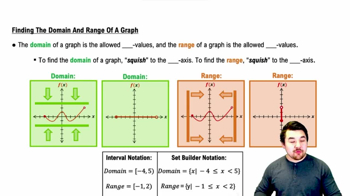
Finding the Domain and Range of a Graph

Range of a Function

The range of a function is the set of all possible output values (y-values) that the function can produce. For the function y = -2 + √(1 - x), the square root function outputs non-negative values, which means the minimum value of y occurs when x is at its maximum in the domain. Analyzing the function helps identify the range based on the values y can take.
Video consigliato:
Percorso guidato
5:10
Finding the Domain and Range of a Graph

Square Root Function

The square root function, denoted as √x, is defined for non-negative values of x and produces non-negative outputs. In the context of the function y = -2 + √(1 - x), the square root affects both the domain and range, as it restricts x to values where 1 - x is non-negative, and it shifts the output down by 2, impacting the overall range.
Video consigliato:
Percorso guidato
7:24
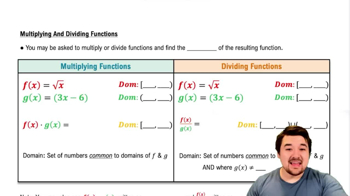
Multiplying & Dividing Functions