Ch. 1 - Functions
Hass - Thomas' Calculus 15th Edition
Hass15th EditionThomas' CalculusISBN: 9780137616077Non è quello che usi tu?Cambia libro di testo
Capitolo 1, Problema 1.32

In Exercises 19–32, find the (a) domain and (b) range.


𝔂 = 3 cos x + 4 sin x (Hint: A trig identity is required.)

Guida verificata passo dopo passo
1
Step 1: Recognize that the function y = 3 cos(x) + 4 sin(x) is a linear combination of sine and cosine functions. The domain of sine and cosine functions is all real numbers, so the domain of y is also all real numbers.
Step 2: To find the range, use the trigonometric identity for a linear combination of sine and cosine: a cos(x) + b sin(x) = R cos(x - φ), where R = √(a² + b²) and φ is a phase shift.
Step 3: Calculate R using the coefficients of the sine and cosine terms: R = √(3² + 4²) = √(9 + 16) = √25 = 5.
Step 4: The expression R cos(x - φ) has a range of [-R, R] because the cosine function oscillates between -1 and 1. Therefore, the range of y = 3 cos(x) + 4 sin(x) is [-5, 5].
Step 5: Conclude that the domain of the function is all real numbers, and the range is [-5, 5].

Risposta video verificata per un problema simile:

Questa soluzione video è stata consigliata dai nostri tutor come utile per risolvere questo problema.
Durata del video:
5m

Concetti chiave

Ecco i concetti essenziali che devi comprendere per rispondere correttamente alla domanda.

Domain of a Function

The domain of a function refers to the set of all possible input values (x-values) for which the function is defined. For trigonometric functions like sine and cosine, the domain is typically all real numbers, as these functions can take any real number as input. However, when combined in an expression, the overall domain may be influenced by other factors, such as restrictions from the context of the problem.
Video consigliato:
Percorso guidato
5:10
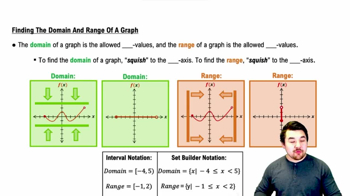
Finding the Domain and Range of a Graph

Range of a Function

The range of a function is the set of all possible output values (y-values) that the function can produce. For the function given, 𝔶 = 3 cos x + 4 sin x, the range can be determined by analyzing the maximum and minimum values of the expression. Using trigonometric identities, one can express this function in a form that reveals its amplitude and thus its range.
Video consigliato:
Percorso guidato
5:10
Finding the Domain and Range of a Graph

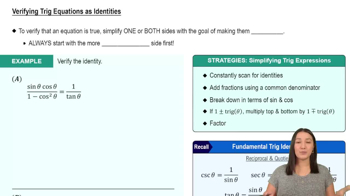
Trigonometric Identities

Trigonometric identities are equations that involve trigonometric functions and are true for all values of the variables involved. A common identity used in problems involving sine and cosine is the Pythagorean identity, which states that sin²(x) + cos²(x) = 1. In this case, a relevant identity can help simplify the expression 3 cos x + 4 sin x into a single sinusoidal function, making it easier to determine the range.
Video consigliato:
7:17
Verifying Trig Equations as Identities