Ch. 1 - Functions
Hass - Thomas' Calculus 15th Edition
Hass15th EditionThomas' CalculusISBN: 9780137616077Non è quello che usi tu?Cambia libro di testo
Capitolo 1, Problema 1.1.43

Increasing and Decreasing Functions


Graph the functions in Exercises 37–46. What symmetries, if any, do the graphs have? Specify the intervals over which the function is increasing and the intervals where it is decreasing.


y = x³/8

Guida verificata passo dopo passo
1
First, identify the function given: \( y = \frac{x^3}{8} \). This is a cubic function, which is generally of the form \( y = ax^3 + bx^2 + cx + d \). In this case, \( a = \frac{1}{8} \), \( b = 0 \), \( c = 0 \), and \( d = 0 \).
To determine the intervals of increase and decrease, find the first derivative of the function. The derivative \( y' \) of \( y = \frac{x^3}{8} \) is \( y' = \frac{3x^2}{8} \).
Analyze the first derivative \( y' = \frac{3x^2}{8} \). Since \( 3x^2 \) is always non-negative and \( \frac{1}{8} \) is positive, \( y' \geq 0 \) for all \( x \). This indicates that the function is non-decreasing everywhere.
Since the derivative is zero only at \( x = 0 \), the function is constant at this point and increasing elsewhere. Therefore, the function is increasing on the intervals \( (-\infty, 0) \) and \( (0, \infty) \).
Check for symmetries: The function \( y = \frac{x^3}{8} \) is an odd function because \( f(-x) = -f(x) \). This means the graph is symmetric with respect to the origin.

Risposta video verificata per un problema simile:

Questa soluzione video è stata consigliata dai nostri tutor come utile per risolvere questo problema.
Durata del video:
4m

Concetti chiave

Ecco i concetti essenziali che devi comprendere per rispondere correttamente alla domanda.

Increasing and Decreasing Functions

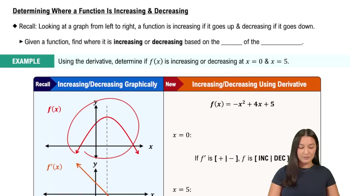
A function is increasing on an interval if, for any two numbers in that interval, a larger input results in a larger output. Conversely, it is decreasing if a larger input results in a smaller output. To determine these intervals, one typically examines the sign of the derivative: positive for increasing and negative for decreasing.
Video consigliato:
07:32
Determining Where a Function is Increasing & Decreasing

Symmetry in Graphs

Symmetry in graphs refers to the property where a graph is invariant under certain transformations, such as reflection or rotation. Common types include even symmetry (y-axis symmetry) and odd symmetry (origin symmetry). For the function y = x³/8, checking for odd symmetry involves verifying if f(-x) = -f(x).
Video consigliato:
Percorso guidato
06:15
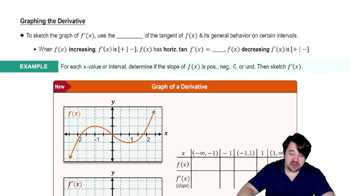
Graphing The Derivative

Derivative and Critical Points

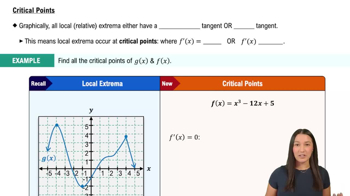
The derivative of a function provides information about its rate of change. Critical points occur where the derivative is zero or undefined, indicating potential local maxima, minima, or points of inflection. For y = x³/8, the derivative y' = (3/8)x² helps identify intervals of increase or decrease by analyzing where it is positive or negative.
Video consigliato:
04:50
Critical Points