Ch. 1 - Functions
Hass - Thomas' Calculus 15th Edition
Hass15th EditionThomas' CalculusISBN: 9780137616077Non è quello che usi tu?Cambia libro di testo
Capitolo 1, Problema 1.1.31a

Piecewise-Defined Functions


Find a formula for each function graphed in Exercises 29–32.


a. <IMAGE>

Guida verificata passo dopo passo
1
Identify the different segments of the graph. A piecewise function is defined by different expressions over different intervals. Look at the graph and note where the function changes its behavior.
Determine the type of function for each segment. Common types include linear, quadratic, or constant functions. Analyze the graph to see if the segments are straight lines, curves, or flat lines.
Find the equations for each segment. For linear segments, use the slope-intercept form \( y = mx + b \), where \( m \) is the slope and \( b \) is the y-intercept. For quadratic segments, use the standard form \( y = ax^2 + bx + c \).
Specify the domain for each piece of the function. The domain is the interval over which each segment is valid. Use the x-values where the function changes to define these intervals.
Combine the equations and domains into a piecewise function. Write the function using the format: \( f(x) = \begin{cases} \text{expression 1,} & \text{if } \text{domain 1} \\ \text{expression 2,} & \text{if } \text{domain 2} \\ \end{cases} \).

Risposta video verificata per un problema simile:

Questa soluzione video è stata consigliata dai nostri tutor come utile per risolvere questo problema.
Durata del video:
5m

Concetti chiave

Ecco i concetti essenziali che devi comprendere per rispondere correttamente alla domanda.

Piecewise-Defined Functions

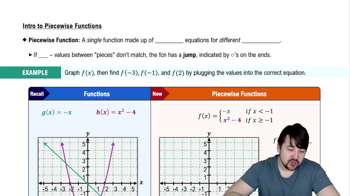
A piecewise-defined function is a function composed of multiple sub-functions, each of which applies to a specific interval of the domain. These functions are defined by different expressions based on the input value. Understanding how to interpret and construct these functions is crucial for analyzing graphs that change behavior at certain points.
Video consigliato:
Percorso guidato
05:36
Piecewise Functions

Graph Interpretation

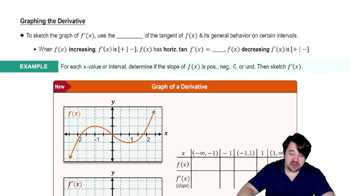
Graph interpretation involves analyzing a visual representation of a function to understand its behavior, such as identifying intervals, slopes, and points of discontinuity. This skill is essential for translating a graph into a piecewise-defined function, as it requires recognizing where the function changes and what expressions describe each segment.
Video consigliato:
Percorso guidato
06:15
Graphing The Derivative

Function Continuity and Discontinuity

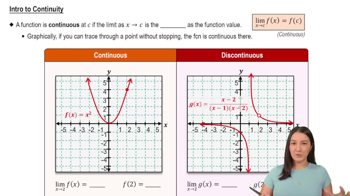
Continuity in a function means that the graph is unbroken, while discontinuity indicates a jump, hole, or asymptote. Identifying these features in a graph is vital for writing piecewise functions, as they often dictate where one piece ends and another begins, and whether the function is defined at those transition points.
Video consigliato:
05:34
Intro to Continuity