
Ch. 1 - Functions
Hass - Thomas' Calculus 15th Edition
Hass15th EditionThomas' CalculusISBN: 9780137616077Non è quello che usi tu?Cambia libro di testo
Capitolo 1, Problema 1.3.1

Radians and Degrees


On a circle of radius 10 m, how long is an arc that subtends a central angle of (a) 4π/5 radians? (b) 110°?

Guida verificata passo dopo passo
1
Step 1: Understand the relationship between arc length, radius, and central angle. The formula for arc length (L) is given by L = rθ, where r is the radius and θ is the central angle in radians.
Step 2: For part (a), identify the given values: radius r = 10 m and central angle θ = 4π/5 radians. Use the formula L = rθ to find the arc length.
Step 3: Substitute the values into the formula for part (a): L = 10 * (4π/5). Simplify the expression to find the arc length in meters.
Step 4: For part (b), convert the central angle from degrees to radians. Recall that 1 degree = π/180 radians. Therefore, 110° = 110 * (π/180) radians.
Step 5: Use the formula L = rθ again for part (b) with the converted angle in radians: L = 10 * (110 * (π/180)). Simplify the expression to find the arc length in meters.

Risposta video verificata per un problema simile:

Questa soluzione video è stata consigliata dai nostri tutor come utile per risolvere questo problema.
Durata del video:
1m

Concetti chiave

Ecco i concetti essenziali che devi comprendere per rispondere correttamente alla domanda.

Arc Length Formula

The arc length of a circle can be calculated using the formula L = rθ, where L is the arc length, r is the radius, and θ is the central angle in radians. This formula is essential for determining the length of an arc based on the angle subtended at the center of the circle.
Video consigliato:
08:29
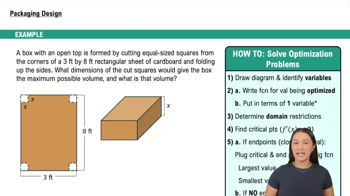
Example 5: Packaging Design

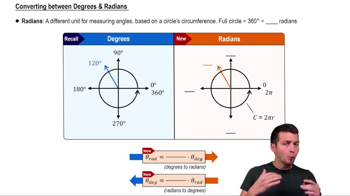
Conversion between Radians and Degrees

Radians and degrees are two units for measuring angles. To convert degrees to radians, use the formula radians = degrees × (π/180). Understanding this conversion is crucial when working with angles in different units, especially in problems involving circular motion.
Video consigliato:
5:04
Converting between Degrees & Radians

Properties of Circles

A circle is defined by its radius, which is the distance from the center to any point on the circle. The relationship between the radius, circumference, and arc length is fundamental in geometry and calculus, as it helps in understanding how angles and distances relate in circular motion.
Video consigliato:
Percorso guidato
06:21
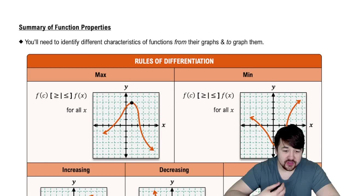
Properties of Functions
Pratica correlata
Domanda del libro di testo

Composition of Functions


A balloon’s volume V is given by V = s² + 2s + 3 cm³, where s is the ambient temperature in °C. The ambient temperature s at time t minutes is given by s = 2t − 3 °C. Write the balloon’s volume V as a function of time t.

206
views
Domanda del libro di testo

Graphing


In Exercises 69–76, graph each function not by plotting points, but by starting with the graph of one of the standard functions presented in Figures 1.14–1.17 and applying an appropriate transformation.


y = (−2x)²/³

202
views
Domanda del libro di testo

A hot-air balloon rising straight up from a level field is tracked by a range finder located 500 ft from the point of liftoff. Express the balloon’s height as a function of the angle the line from the range finder to the balloon makes with the ground.

281
views
Domanda del libro di testo

Finding a Viewing Window


In Exercises 5–30, find an appropriate graphing software viewing window for the given function and use it to display that function’s graph. The window should give a picture of the overall behavior of the function. There is more than one choice, but incorrect choices can miss important aspects of the function.


f(x) = (x² − 1)/(x² + 1)

270
views
Domanda del libro di testo

Finding Formulas for Functions


A point P in the first quadrant lies on the graph of the function f(x) = √x. Express the coordinates of P as functions of the slope of the line joining P to the origin.

362
views
Domanda del libro di testo

Piecewise-Defined Functions


In Exercises 35 and 36, find the (a) domain and (b) range.


𝔂 = { √ -x, -4 ≤ x ≤ 0

{ √ x, 0 < x ≤ 4

249
views