Ch. 1 - Functions
Hass - Thomas' Calculus 15th Edition
Hass15th EditionThomas' CalculusISBN: 9780137616077Non è quello che usi tu?Cambia libro di testo
Capitolo 1, Problema 1.2.23

Shifting Graphs


The accompanying figure shows the graph of y = −x² shifted to two new positions. Write equations for the new graphs.


<IMAGE>

Guida verificata passo dopo passo
1
Identify the original function: The original function given is y = -x². This is a downward-opening parabola centered at the origin (0,0).
Understand graph shifts: A graph can be shifted horizontally and/or vertically. A horizontal shift involves adding or subtracting a constant from the x-variable, while a vertical shift involves adding or subtracting a constant from the entire function.
Determine horizontal shifts: If the graph is shifted to the right by 'h' units, the equation becomes y = -(x-h)². If shifted to the left by 'h' units, it becomes y = -(x+h)².
Determine vertical shifts: If the graph is shifted upwards by 'k' units, the equation becomes y = -x² + k. If shifted downwards by 'k' units, it becomes y = -x² - k.
Combine shifts for new equations: If the graph is shifted both horizontally by 'h' units and vertically by 'k' units, the new equation is y = -(x-h)² + k. Use the information from the image to determine the specific values of 'h' and 'k' for each new graph position.

Risposta video verificata per un problema simile:

Questa soluzione video è stata consigliata dai nostri tutor come utile per risolvere questo problema.
Durata del video:
2m

Concetti chiave

Ecco i concetti essenziali che devi comprendere per rispondere correttamente alla domanda.

Graph Shifting

Graph shifting involves translating a function's graph horizontally or vertically without altering its shape. A vertical shift occurs when a constant is added or subtracted from the function, while a horizontal shift involves adding or subtracting from the input variable. For example, the function y = -x² shifted up by 3 units becomes y = -x² + 3.
Video consigliato:
Percorso guidato
5:53
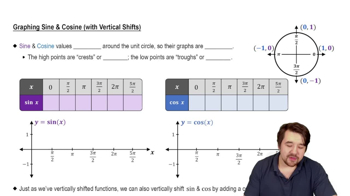
Graph of Sine and Cosine Function

Quadratic Functions

Quadratic functions are polynomial functions of degree two, typically expressed in the form y = ax² + bx + c. The graph of a quadratic function is a parabola, which can open upwards or downwards depending on the sign of 'a'. Understanding the standard form helps in identifying the vertex and the direction of the parabola, which is crucial when shifting the graph.
Video consigliato:
6:04
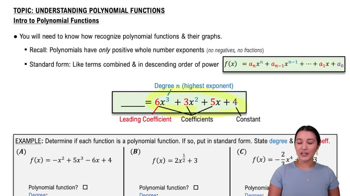
Introduction to Polynomial Functions

Transformation of Functions

Transformations of functions include various operations that change the position or shape of the graph. These transformations can be translations, reflections, stretches, or compressions. In the context of the given question, recognizing how to apply vertical and horizontal shifts to the original quadratic function is essential for writing the equations of the new graphs.
Video consigliato:
Percorso guidato
5:25
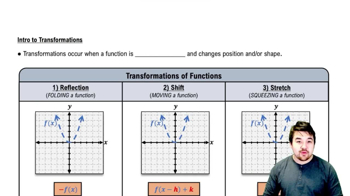
Intro to Transformations