Ch. 1 - Functions
Hass - Thomas' Calculus 15th Edition
Hass15th EditionThomas' CalculusISBN: 9780137616077Non è quello che usi tu?Cambia libro di testo
Capitolo 1, Problema 61

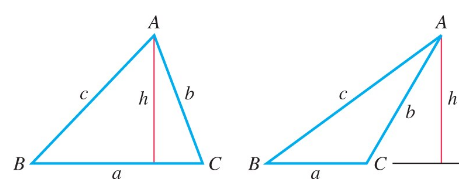
The law of sines The law of sines says that if a, b, and c are the sides opposite the angles A, B, and C in a triangle, then


(sin A) / a = (sin B) / b = (sin C) / c


Use the accompanying figures and the identity sin (π − θ) = sin θ, if required, to derive the law.


tri

Guida verificata passo dopo passo
1
Start by considering a triangle with sides a, b, and c opposite to angles A, B, and C respectively. The goal is to relate the sides and angles using the law of sines.
Recall the formula for the area of a triangle: Area = (1/2) * base * height. For triangle ABC, you can express the area using each side as the base. For example, using side a as the base, the height is b * sin(C), so the area is (1/2) * a * b * sin(C).
Similarly, express the area using side b as the base: Area = (1/2) * b * c * sin(A), and using side c as the base: Area = (1/2) * c * a * sin(B).
Since all these expressions represent the same area, set them equal to each other: (1/2) * a * b * sin(C) = (1/2) * b * c * sin(A) = (1/2) * c * a * sin(B).
Divide each part of the equation by the product of the sides involved to isolate the sine terms: (sin A) / a = (sin B) / b = (sin C) / c. This is the law of sines, which shows the relationship between the sides and angles of a triangle.

Risposta video verificata per un problema simile:

Questa soluzione video è stata consigliata dai nostri tutor come utile per risolvere questo problema.
Durata del video:
6m

Concetti chiave

Ecco i concetti essenziali che devi comprendere per rispondere correttamente alla domanda.

Law of Sines

The Law of Sines is a fundamental relationship in trigonometry that relates the angles and sides of a triangle. It states that the ratio of the length of a side of a triangle to the sine of its opposite angle is constant for all three sides and angles. This can be expressed mathematically as (sin A) / a = (sin B) / b = (sin C) / c, where A, B, and C are the angles, and a, b, and c are the lengths of the sides opposite those angles.
Video consigliato:
Percorso guidato
05:40
Work Done On A Spring (Hooke's Law)

Trigonometric Identities

Trigonometric identities are equations that involve trigonometric functions and are true for all values of the variables involved. One important identity is sin(π - θ) = sin θ, which indicates that the sine function is symmetric about π/2. This identity can be useful in deriving relationships in triangles, particularly when working with angles that sum to π or 180 degrees.
Video consigliato:
7:17
Verifying Trig Equations as Identities

Triangle Properties

Understanding the properties of triangles is essential for applying the Law of Sines. A triangle's angles always sum to 180 degrees, and the relationship between the angles and sides is crucial for solving problems. Additionally, knowing how to identify and label the sides and angles correctly is vital for applying the Law of Sines effectively in various geometric contexts.
Video consigliato:
Percorso guidato
06:21
Properties of Functions