Ch. 10 - Infinite Sequences and Series
Hass - Thomas' Calculus 15th Edition
Hass15th EditionThomas' CalculusISBN: 9780137616077Non è quello che usi tu?Cambia libro di testo
Capitolo 10, Problema 10.1.81

Convergence and Divergence
Which of the sequences {aₙ} in Exercises 31–100 converge, and which diverge? Find the limit of each convergent sequence.
aₙ = (xⁿ / (2n + 1))^(1/n),x > 0

Guida verificata passo dopo passo
1
First, write down the given sequence explicitly: \(a_n = \left( \frac{x^n}{2n + 1} \right)^{\frac{1}{n}}\) where \(x > 0\).
Rewrite the sequence inside the \(n\)th root to separate the terms: \(a_n = \left( x^n \right)^{\frac{1}{n}} \cdot \left( \frac{1}{2n + 1} \right)^{\frac{1}{n}}\).
Simplify the powers: \(a_n = x \cdot \left( \frac{1}{2n + 1} \right)^{\frac{1}{n}}\).
Analyze the limit of the second factor as \(n \to \infty\): consider \(\lim_{n \to \infty} \left( \frac{1}{2n + 1} \right)^{\frac{1}{n}}\).
Use the fact that \(\lim_{n \to \infty} a_n^{1/n} = 1\) for any sequence \(a_n\) that tends to infinity, so this limit approaches 1. Therefore, the limit of \(a_n\) is \(x \cdot 1 = x\). Conclude that the sequence converges to \(x\).

Risposta video verificata per un problema simile:

Questa soluzione video è stata consigliata dai nostri tutor come utile per risolvere questo problema.
Durata del video:
5m

Concetti chiave

Ecco i concetti essenziali che devi comprendere per rispondere correttamente alla domanda.

Sequence Convergence and Divergence

A sequence converges if its terms approach a specific finite limit as n approaches infinity; otherwise, it diverges. Understanding this helps determine the behavior of {aₙ} by analyzing its limit. Convergence implies stability in the sequence's values, while divergence indicates unbounded or oscillatory behavior.
Video consigliato:
8:22
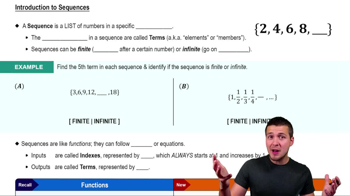
Introduction to Sequences

Limit of a Sequence

The limit of a sequence {aₙ} is the value that the terms approach as n becomes very large. Calculating this limit often involves algebraic manipulation or applying limit laws. For the given sequence, finding the limit involves evaluating the nth root and the behavior of xⁿ and the denominator as n grows.
Video consigliato:
8:22
Introduction to Sequences

nth Root and Exponential Growth

The nth root function, ( )^(1/n), moderates growth rates by reducing exponential terms. Since xⁿ grows exponentially, taking the nth root can simplify the expression to a form involving x. Understanding how the nth root interacts with exponential and polynomial terms is crucial to finding the sequence's limit.
Video consigliato:
09:29
Exponential Growth & Decay