Ch. 10 - Infinite Sequences and Series
Hass - Thomas' Calculus 15th Edition
Hass15th EditionThomas' CalculusISBN: 9780137616077Non è quello che usi tu?Cambia libro di testo
Capitolo 10, Problema 10.1.36

Convergence and Divergence
Which of the sequences {aₙ} in Exercises 31–100 converge, and which diverge? Find the limit of each convergent sequence.
aₙ = (n + 3) / (n² + 5n + 6)

Guida verificata passo dopo passo
1
Identify the given sequence: \(a_n = \frac{n + 3}{n^2 + 5n + 6}\).
To analyze convergence or divergence, examine the behavior of \(a_n\) as \(n\) approaches infinity, i.e., find \(\lim_{n \to \infty} a_n\).
Since the sequence is a rational function of \(n\), compare the degrees of the numerator and denominator polynomials. The numerator is degree 1, and the denominator is degree 2.
Divide both numerator and denominator by the highest power of \(n\) in the denominator, which is \(n^2\), to simplify the limit expression: \(a_n = \frac{\frac{n}{n^2} + \frac{3}{n^2}}{\frac{n^2}{n^2} + \frac{5n}{n^2} + \frac{6}{n^2}} = \frac{\frac{1}{n} + \frac{3}{n^2}}{1 + \frac{5}{n} + \frac{6}{n^2}}\).
Evaluate the limit by letting \(n\) approach infinity, noting that terms with \(\frac{1}{n}\) and \(\frac{1}{n^2}\) approach zero, and conclude whether the sequence converges or diverges based on this limit.

Risposta video verificata per un problema simile:

Questa soluzione video è stata consigliata dai nostri tutor come utile per risolvere questo problema.
Durata del video:
2m

Concetti chiave

Ecco i concetti essenziali che devi comprendere per rispondere correttamente alla domanda.

Sequence Convergence and Divergence

A sequence converges if its terms approach a specific finite value as n approaches infinity; otherwise, it diverges. Understanding this helps determine the behavior of {aₙ} as n grows large.
Video consigliato:
8:22
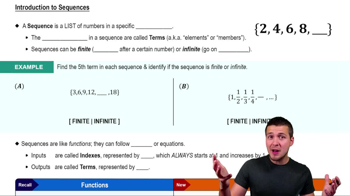
Introduction to Sequences

Limits of Sequences

The limit of a sequence is the value that the terms get arbitrarily close to as n becomes very large. Calculating limits often involves simplifying expressions and applying limit laws.
Video consigliato:
8:22
Introduction to Sequences

Asymptotic Behavior of Rational Functions

For sequences defined by rational functions like (n + 3)/(n² + 5n + 6), analyzing the degrees of numerator and denominator polynomials helps determine the limit, since higher-degree denominators typically drive the sequence to zero.
Video consigliato:
Percorso guidato
5:50
Asymptotes of Hyperbolas