
Ch. 10 - Infinite Sequences and Series
Hass - Thomas' Calculus 15th Edition
Hass15th EditionThomas' CalculusISBN: 9780137616077Non è quello che usi tu?Cambia libro di testo
Capitolo 10, Problema 10.6.10

Determining Convergence or Divergence
In Exercises 1–14, determine whether the alternating series converges or diverges. Some of the series do not satisfy the conditions of the Alternating Series Test.
∑ (from n = 2 to ∞) [(-1)ⁿ⁺¹ (1 / ln n)]

Guida verificata passo dopo passo
1
Identify the general term of the series: \(a_n = \frac{1}{\ln n}\) and the alternating factor is \((-1)^{n+1}\), so the series is \(\sum_{n=2}^\infty (-1)^{n+1} a_n\).
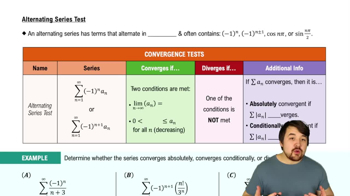
Recall the Alternating Series Test (Leibniz Test), which states that an alternating series \(\sum (-1)^n a_n\) converges if two conditions are met: (1) the sequence \(a_n\) is positive, decreasing, and (2) \(\lim_{n \to \infty} a_n = 0\).
Check if \(a_n = \frac{1}{\ln n}\) is positive and decreasing for \(n \geq 2\). Since \(\ln n\) is positive and increasing for \(n > 1\), \(a_n\) is positive and decreasing for \(n \geq 2\).
Evaluate the limit \(\lim_{n \to \infty} \frac{1}{\ln n}\). Since \(\ln n\) grows without bound as \(n\) approaches infinity, this limit is 0.
Since both conditions of the Alternating Series Test are satisfied, conclude that the series \(\sum_{n=2}^\infty (-1)^{n+1} \frac{1}{\ln n}\) converges.

Risposta video verificata per un problema simile:

Questa soluzione video è stata consigliata dai nostri tutor come utile per risolvere questo problema.
Durata del video:
3m

Concetti chiave

Ecco i concetti essenziali che devi comprendere per rispondere correttamente alla domanda.

Alternating Series Test

The Alternating Series Test determines convergence of series whose terms alternate in sign. It requires that the absolute value of terms decreases monotonically to zero. If these conditions hold, the series converges; otherwise, the test is inconclusive.
Video consigliato:
Percorso guidato
10:54
Alternating Series Test

Behavior of the General Term

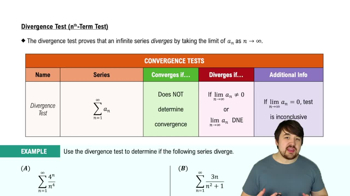
Analyzing the limit of the general term as n approaches infinity is crucial. For convergence, the terms must approach zero. In this series, the term 1/ln(n) decreases slowly, so checking its limit helps assess if the series can converge.
Video consigliato:
Percorso guidato
05:44
Divergence Test (nth Term Test)

Logarithmic Functions and Their Growth

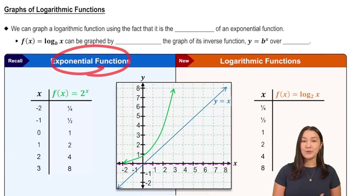
Understanding the growth rate of the natural logarithm function ln(n) is important. Since ln(n) grows without bound but very slowly, 1/ln(n) approaches zero but not rapidly. This slow decay affects the convergence behavior of the series.
Video consigliato:
5:26
Graphs of Logarithmic Functions