Ch. 10 - Infinite Sequences and Series
Hass - Thomas' Calculus 15th Edition
Hass15th EditionThomas' CalculusISBN: 9780137616077Non è quello che usi tu?Cambia libro di testo
Capitolo 10, Problema 10.4.17

Determining Convergence or Divergence
Which of the series in Exercises 17–56 converge, and which diverge? Use any method, and give reasons for your answers.
∑ (from n=1 to ∞) 1 / (2√n + ³√n)

Guida verificata passo dopo passo
1
Identify the general term of the series: \(a_n = \frac{1}{2\sqrt{n} + \sqrt[3]{n}}\).
Analyze the behavior of the denominator for large \(n\). Since \(\sqrt{n} = n^{1/2}\) and \(\sqrt[3]{n} = n^{1/3}\), the term \(2\sqrt{n}\) grows faster than \(\sqrt[3]{n}\) as \(n\) increases.
Approximate the general term for large \(n\) by focusing on the dominant term in the denominator: \(a_n \approx \frac{1}{2n^{1/2}}\).
Compare the series to a known benchmark series, such as the \(p\)-series \(\sum \frac{1}{n^p}\), where convergence depends on \(p\). Here, the comparison is with \(\sum \frac{1}{n^{1/2}}\).
Recall that the \(p\)-series \(\sum \frac{1}{n^p}\) converges if and only if \(p > 1\). Since \(1/2 < 1\), the comparison series diverges, so by the Comparison Test, the original series also diverges.

Risposta video verificata per un problema simile:

Questa soluzione video è stata consigliata dai nostri tutor come utile per risolvere questo problema.
Durata del video:
7m

Concetti chiave

Ecco i concetti essenziali che devi comprendere per rispondere correttamente alla domanda.

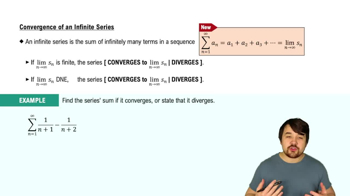
Infinite Series and Convergence

An infinite series is the sum of infinitely many terms. Determining whether a series converges means checking if the sum approaches a finite limit as the number of terms grows indefinitely. If the sum does not approach a finite value, the series diverges.
Video consigliato:
Percorso guidato
06:52
Convergence of an Infinite Series

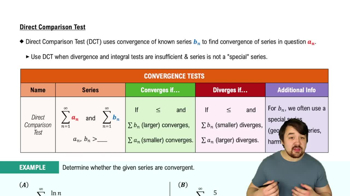
Comparison Test

The Comparison Test helps determine convergence by comparing the given series to a known benchmark series. If the terms of the given series are smaller than those of a convergent series, it also converges; if larger than a divergent series, it diverges. This test is useful when terms are positive and can be bounded.
Video consigliato:
Percorso guidato
09:25
Direct Comparison Test

Asymptotic Behavior of Terms

Analyzing the dominant behavior of terms for large n helps simplify complex expressions. For example, in 1/(2√n + ³√n), the term with the slower decay rate (smaller exponent) dominates. Understanding which term controls the behavior is key to applying convergence tests effectively.
Video consigliato:
Percorso guidato
5:50
Asymptotes of Hyperbolas