Ch. 10 - Infinite Sequences and Series
Hass - Thomas' Calculus 15th Edition
Hass15th EditionThomas' CalculusISBN: 9780137616077Non è quello che usi tu?Cambia libro di testo
Capitolo 10, Problema 10.3.53b

∑ (from n=1 to ∞) (1 / √(n + 1)) diverges
b. What should n be in order that the partial sum sₙ = ∑ (from i=1 to n) (1 / √(i + 1)) satisfies sₙ > 1000?

Guida verificata passo dopo passo
1
Recognize that the series \( \sum_{n=1}^{\infty} \frac{1}{\sqrt{n+1}} \) diverges, meaning its partial sums grow without bound as \( n \to \infty \). Therefore, for any large number like 1000, there exists some \( n \) such that the partial sum \( s_n = \sum_{i=1}^n \frac{1}{\sqrt{i+1}} \) exceeds 1000.
To estimate the value of \( n \) for which \( s_n > 1000 \), use the integral test approximation. Since \( f(x) = \frac{1}{\sqrt{x+1}} \) is positive and decreasing for \( x \geq 1 \), the sum \( s_n \) can be approximated by the integral \( \int_1^{n} \frac{1}{\sqrt{x+1}} \, dx \).
Set up the integral \( I = \int_1^{n} \frac{1}{\sqrt{x+1}} \, dx \). To solve this integral, perform the substitution \( u = x + 1 \), so \( du = dx \), and the limits change from \( x=1 \) to \( u=2 \), and \( x=n \) to \( u = n+1 \). The integral becomes \( \int_2^{n+1} u^{-1/2} \, du \).
Evaluate the integral \( \int_2^{n+1} u^{-1/2} \, du = 2(\sqrt{n+1} - \sqrt{2}) \). This gives an approximation for the partial sum \( s_n \) as \( s_n \approx 2(\sqrt{n+1} - \sqrt{2}) \).
Set the inequality \( 2(\sqrt{n+1} - \sqrt{2}) > 1000 \) to find the smallest \( n \) such that the partial sum exceeds 1000. Solve this inequality for \( n \) by isolating \( \sqrt{n+1} \) and then squaring both sides to find \( n \).

Risposta video verificata per un problema simile:

Questa soluzione video è stata consigliata dai nostri tutor come utile per risolvere questo problema.
Durata del video:
6m

Concetti chiave

Ecco i concetti essenziali che devi comprendere per rispondere correttamente alla domanda.

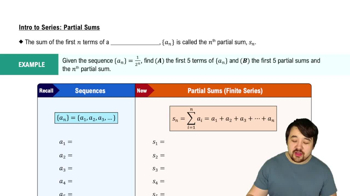
Infinite Series and Partial Sums

An infinite series is the sum of infinitely many terms, and its partial sums are the sums of the first n terms. Understanding how partial sums behave helps determine how large n must be for the sum to exceed a certain value, even if the series diverges.
Video consigliato:
Percorso guidato
06:45
Intro to Series: Partial Sums

Divergence of a Series

A series diverges if its partial sums do not approach a finite limit as n approaches infinity. The given series ∑ 1/√(n+1) diverges because its terms decrease too slowly, meaning the sum grows without bound, which is crucial for knowing that sₙ can exceed any finite number.
Video consigliato:
Percorso guidato
06:00
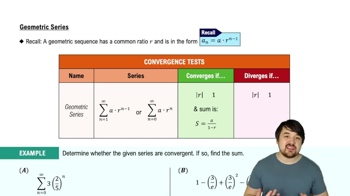
Geometric Series

Integral Test for Series Estimation

The integral test compares a series to an improper integral to estimate the size of partial sums. For decreasing positive terms like 1/√(n+1), the integral of 1/√x from 1 to n approximates the partial sum, helping to find n such that sₙ > 1000.
Video consigliato:
Percorso guidato
10:54
Alternating Series Test