Ch. 10 - Infinite Sequences and Series
Hass - Thomas' Calculus 15th Edition
Hass15th EditionThomas' CalculusISBN: 9780137616077Non è quello che usi tu?Cambia libro di testo
Capitolo 10, Problema 10.7.2

Intervals of Convergence
In Exercises 1–36, (a) find the series’ radius and interval of convergence. For what values of x does the series converge (b) absolutely, (c) conditionally?
∑ (from n = 0 to ∞) (x + 5)ⁿ

Guida verificata passo dopo passo
1
Identify the given power series: \(\sum_{n=0}^{\infty} (x + 5)^n\). This is a geometric series with the common ratio \(r = x + 5\).
Recall that a geometric series \(\sum r^n\) converges if and only if \(|r| < 1\). So, set up the inequality \(|x + 5| < 1\) to find the interval of convergence.
Solve the inequality \(|x + 5| < 1\) to find the open interval for \(x\). This will give you the radius of convergence \(R\) and the center of the interval.
Check the endpoints of the interval \(x = -5 - 1\) and \(x = -5 + 1\) by substituting them back into the series to determine if the series converges at these points (this will help find the exact interval of convergence).
Determine absolute convergence by checking if the series converges when taking the absolute value of the terms, and conditional convergence by checking if the series converges but not absolutely at the endpoints.

Risposta video verificata per un problema simile:

Questa soluzione video è stata consigliata dai nostri tutor come utile per risolvere questo problema.
Durata del video:
11m

Concetti chiave

Ecco i concetti essenziali che devi comprendere per rispondere correttamente alla domanda.

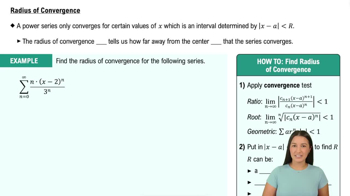
Radius and Interval of Convergence

The radius of convergence is the distance from the center of a power series within which the series converges. The interval of convergence includes all x-values for which the series converges, typically centered around a point (here, -5). Finding these involves using tests like the Ratio Test to determine where the series converges absolutely.
Video consigliato:
07:36
Radius of Convergence

Absolute Convergence

A series converges absolutely if the series of the absolute values of its terms converges. Absolute convergence guarantees convergence regardless of term signs, making it a stronger form of convergence. For power series, absolute convergence usually holds inside the radius of convergence.
Video consigliato:
Percorso guidato
07:51
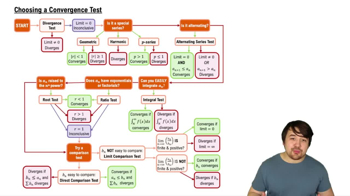
Choosing a Convergence Test

Conditional Convergence

Conditional convergence occurs when a series converges, but does not converge absolutely. This means the series converges only because of the specific arrangement or signs of its terms. At the endpoints of the interval of convergence, a series may converge conditionally, requiring separate testing.
Video consigliato:
Percorso guidato
07:51
Choosing a Convergence Test