Ch. 11 - Parametric Equations and Polar Coordinates
Hass - Thomas' Calculus 15th Edition
Hass15th EditionThomas' CalculusISBN: 9780137616077Non è quello che usi tu?Cambia libro di testo
Capitolo 11, Problema 11.2.39

Centroids


Find the coordinates of the centroid of the curve x = cos t, y = t + sin t, 0 ≤ t ≤ π.

Guida verificata passo dopo passo
1
Recall that the centroid (or center of mass) of a curve defined parametrically by \(x = x(t)\) and \(y = y(t)\) over an interval \(a \leq t \leq b\) is given by the coordinates \(\left( \bar{x}, \bar{y} \right)\), where:
Write the formulas for the centroid coordinates of a curve: \(\displaystyle \bar{x} = \frac{\int_a^b x(t) \sqrt{\left( \frac{dx}{dt} \right)^2 + \left( \frac{dy}{dt} \right)^2} \, dt}{\int_a^b \sqrt{\left( \frac{dx}{dt} \right)^2 + \left( \frac{dy}{dt} \right)^2} \, dt}\) and \(\displaystyle \bar{y} = \frac{\int_a^b y(t) \sqrt{\left( \frac{dx}{dt} \right)^2 + \left( \frac{dy}{dt} \right)^2} \, dt}{\int_a^b \sqrt{\left( \frac{dx}{dt} \right)^2 + \left( \frac{dy}{dt} \right)^2} \, dt}\)
Calculate the derivatives \(\frac{dx}{dt}\) and \(\frac{dy}{dt}\) for the given parametric equations: Since \(x = \cos t\), then \(\frac{dx}{dt} = -\sin t\). Since \(y = t + \sin t\), then \(\frac{dy}{dt} = 1 + \cos t\).
Substitute \(x(t)\), \(y(t)\), \(\frac{dx}{dt}\), and \(\frac{dy}{dt}\) into the centroid formulas and set up the integrals over the interval \(0 \leq t \leq \pi\): \(\displaystyle \bar{x} = \frac{\int_0^{\pi} \cos t \sqrt{(-\sin t)^2 + (1 + \cos t)^2} \, dt}{\int_0^{\pi} \sqrt{(-\sin t)^2 + (1 + \cos t)^2} \, dt}\) \(\displaystyle \bar{y} = \frac{\int_0^{\pi} (t + \sin t) \sqrt{(-\sin t)^2 + (1 + \cos t)^2} \, dt}{\int_0^{\pi} \sqrt{(-\sin t)^2 + (1 + \cos t)^2} \, dt}\)
Evaluate the integrals in the numerator and denominator separately (using appropriate integration techniques or numerical methods if necessary), then divide to find the coordinates \(\bar{x}\) and \(\bar{y}\) of the centroid.

Risposta video verificata per un problema simile:

Questa soluzione video è stata consigliata dai nostri tutor come utile per risolvere questo problema.
Durata del video:
21m

Concetti chiave

Ecco i concetti essenziali che devi comprendere per rispondere correttamente alla domanda.

Parametric Curves

Parametric curves represent a set of points defined by functions of a parameter, typically t. Here, x and y are given as functions of t, allowing the curve to be traced as t varies. Understanding how to work with parametric equations is essential for analyzing the shape and properties of the curve.
Video consigliato:
Percorso guidato
06:49
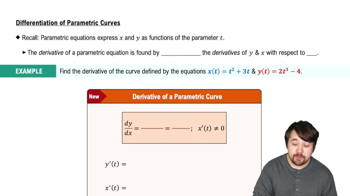
Differentiation of Parametric Curves

Centroid of a Curve

The centroid (or center of mass) of a curve is the average position of all points on the curve, weighted by arc length. It is found by integrating the coordinates multiplied by the differential arc length over the curve and dividing by the total arc length. This concept generalizes the idea of the midpoint to continuous curves.
Video consigliato:
11:41
Summary of Curve Sketching

Arc Length Differential for Parametric Curves

The differential arc length, ds, for a parametric curve x(t), y(t) is given by ds = √((dx/dt)² + (dy/dt)²) dt. This formula is crucial for integrating along the curve to find quantities like the centroid, as it accounts for the actual distance traveled along the curve rather than just the parameter interval.
Video consigliato:
Percorso guidato
06:29
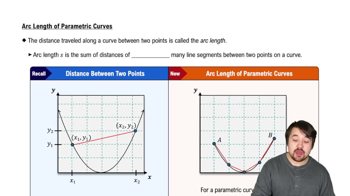
Arc Length of Parametric Curves