Domanda del libro di testo
Examples of Polar Equations
[Technology Exercise] Graph the lines and conic sections in Exercises 65–74.
r = −2 cos θ
7
views

 Hass 15th EditionCh. 11 - Parametric Equations and Polar CoordinatesProblema 11.1.36
 Guida verificata passo dopo passo
 08:02
08:02
 05:21
05:21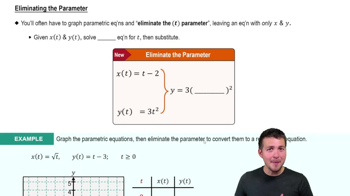 05:59
05:59Examples of Polar Equations
[Technology Exercise] Graph the lines and conic sections in Exercises 65–74.
r = −2 cos θ
Cartesian to Polar Equations
Replace the Cartesian equations in Exercises 53–66 with equivalent polar equations.
x - y = 3
Polar to Cartesian Equations
Replace the polar equations in Exercises 27–52 with equivalent Cartesian equations. Then describe or identify the graph.
r² = 4r sin θ
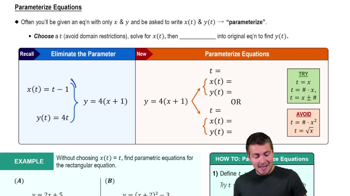
Finding Parametric Equations
In Exercises 31–36, find a parametrization for the curve.
the line segment with endpoints (-1,3) and (3,-2)
Finding Cartesian from Parametric Equations
Exercises 1–18 give parametric equations and parameter intervals for the motion of a particle in the xy-plane. Identify the particle’s path by finding a Cartesian equation for it. Graph the Cartesian equation. (The graphs will vary with the equation used.) Indicate the portion of the graph traced by the particle and the direction of motion.
x = 1 + sin t, y = cos t − 2, 0 ≤ t ≤ π
Symmetries and Polar Graphs
Identify the symmetries of the curves in Exercises 1–12. Then sketch the curves in the xy-plane.
r = 1 + 2 sin θ