Ch. 11 - Parametric Equations and Polar Coordinates
Hass - Thomas' Calculus 15th Edition
Hass15th EditionThomas' CalculusISBN: 9780137616077Non è quello che usi tu?Cambia libro di testo
Capitolo 11, Problema 11.5.10

Finding Polar Areas


Find the areas of the regions in Exercises 9–18.


Shared by the circles r = 1 and r = 2 sin θ

Guida verificata passo dopo passo
1
Identify the curves given: the circles are described by the polar equations \(r = 1\) and \(r = 2 \sin \theta\).
Find the points of intersection by setting the two equations equal: \(1 = 2 \sin \theta\). Solve for \(\theta\) to determine the limits of integration.
Determine which curve lies inside and which lies outside between the points of intersection by testing values of \(\theta\) in the interval.
Set up the integral(s) for the area of the region(s) bounded by the curves. Recall that the area enclosed by a polar curve \(r(\theta)\) from \(\alpha\) to \(\beta\) is given by \(\frac{1}{2} \int_{\alpha}^{\beta} r(\theta)^2 \, d\theta\).
Express the total area as the sum or difference of integrals of \(\frac{1}{2} r^2\) for each curve over the appropriate intervals, based on which curve is outer or inner in each region.

Risposta video verificata per un problema simile:

Questa soluzione video è stata consigliata dai nostri tutor come utile per risolvere questo problema.
Durata del video:
5m

Concetti chiave

Ecco i concetti essenziali che devi comprendere per rispondere correttamente alla domanda.

Polar Coordinates and Graphing

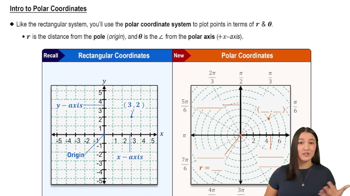
Polar coordinates represent points using a radius and an angle (r, θ) instead of Cartesian coordinates. Understanding how to graph polar equations like r = 1 and r = 2 sin θ is essential to visualize the regions whose areas are to be found.
Video consigliato:
05:32
Intro to Polar Coordinates

Area Calculation in Polar Coordinates

The area enclosed by a polar curve r(θ) between angles α and β is given by the integral (1/2) ∫ from α to β of [r(θ)]² dθ. This formula is fundamental for finding areas bounded by one or more polar curves.
Video consigliato:
05:32
Intro to Polar Coordinates

Finding Points of Intersection in Polar Curves

To determine the limits of integration, it is necessary to find where the polar curves intersect by solving r₁(θ) = r₂(θ). These intersection points define the boundaries of the shared region for accurate area calculation.
Video consigliato:
Percorso guidato
09:04
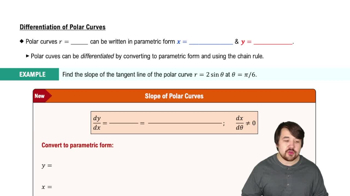
Slope of Polar Curves
Pratica correlata
Domanda del libro di testo

Identifying Graphs


Match the parabolas in Exercises 1−4 with the following equations: x² = 2y, x² = −6y, y² = 8x, y² = −4x


Then find each parabola's focus and directrix.


36
views

Domanda del libro di testo

Ellipses and Eccentricity


Exercises 9–12 give the foci or vertices and the eccentricities of ellipses centered at the origin of the xy-plane. In each case, find the ellipse’s standard-form equation in Cartesian coordinates.


Vertices: (±10,0)

Eccentricity: 0.24

6
views
Domanda del libro di testo

Surface Area


Find the areas of the surfaces generated by revolving the curves in Exercises 31-34 about the indicated axes.


x = t + √2, y = (t²/2) + √2t, −√2 ≤ t ≤ √2; y−axis

24
views
Domanda del libro di testo

Cartesian to Polar Equations


Replace the Cartesian equations in Exercises 53–66 with equivalent polar equations.

(x + 2)² + (y − 5)² = 16"

37
views
Domanda del libro di testo

Finding Cartesian from Parametric Equations


Exercises 1–18 give parametric equations and parameter intervals for the motion of a particle in the xy-plane. Identify the particle’s path by finding a Cartesian equation for it. Graph the Cartesian equation. (The graphs will vary with the equation used.) Indicate the portion of the graph traced by the particle and the direction of motion.


x=√(t+1), y=√t, t ≥ 0

35
views
Domanda del libro di testo

Hyperbolas and Eccentricity


In Exercises 17-24, find the eccentricity of the hyperbola. Then find and graph the hyperbola's foci and directrices.


y² − x² = 4

37
views