
Ch. 11 - Parametric Equations and Polar Coordinates
Hass - Thomas' Calculus 15th Edition
Hass15th EditionThomas' CalculusISBN: 9780137616077Non è quello che usi tu?Cambia libro di testo
Capitolo 11, Problema 11.PE.54

Length in Polar Coordinates


Find the lengths of the curves given by the polar coordinate equations in Exercises 51–54.


r = √(1 + cos 2θ), −π/2 ≤ θ ≤ π/2

Guida verificata passo dopo passo
1
Recall the formula for the length of a curve given in polar coordinates: the arc length \( L \) from \( \theta = a \) to \( \theta = b \) is given by \[ L = \int_{a}^{b} \sqrt{r(\theta)^2 + \left(\frac{dr}{d\theta}\right)^2} \, d\theta \]
Identify the given function and interval: here, \( r(\theta) = \sqrt{1 + \cos 2\theta} \) and the interval is \( -\frac{\pi}{2} \leq \theta \leq \frac{\pi}{2} \).
Compute the derivative \( \frac{dr}{d\theta} \). Since \( r(\theta) = (1 + \cos 2\theta)^{1/2} \), use the chain rule: \[ \frac{dr}{d\theta} = \frac{1}{2}(1 + \cos 2\theta)^{-1/2} \cdot (-2 \sin 2\theta) = -\frac{\sin 2\theta}{\sqrt{1 + \cos 2\theta}} \]
Substitute \( r(\theta) \) and \( \frac{dr}{d\theta} \) into the arc length formula: \[ L = \int_{-\frac{\pi}{2}}^{\frac{\pi}{2}} \sqrt{\left(\sqrt{1 + \cos 2\theta}\right)^2 + \left(-\frac{\sin 2\theta}{\sqrt{1 + \cos 2\theta}}\right)^2} \, d\theta \]
Simplify the expression inside the square root and then evaluate the integral over the given interval to find the length of the curve.

Risposta video verificata per un problema simile:

Questa soluzione video è stata consigliata dai nostri tutor come utile per risolvere questo problema.
Durata del video:
3m

Concetti chiave

Ecco i concetti essenziali che devi comprendere per rispondere correttamente alla domanda.

Arc Length in Polar Coordinates

The arc length of a curve defined in polar coordinates r(θ) from θ = a to θ = b is given by the integral ∫_a^b √(r(θ)^2 + (dr/dθ)^2) dθ. This formula accounts for both the radial distance and the rate of change of the radius with respect to the angle, allowing calculation of the curve's length.
Video consigliato:
05:32
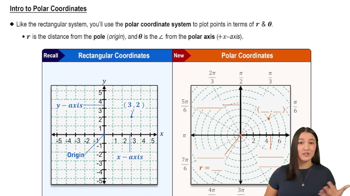
Intro to Polar Coordinates

Differentiation of Polar Functions

To find the derivative dr/dθ, you must differentiate the given polar function r(θ) with respect to θ. This step is essential for the arc length formula and often involves applying chain and trigonometric differentiation rules, especially when r is expressed with trigonometric functions like cos(2θ).
Video consigliato:
05:32
Intro to Polar Coordinates

Trigonometric Identities and Simplification

Using trigonometric identities, such as double-angle formulas, can simplify expressions involving cos(2θ) or sin(2θ). Simplifying r(θ) and its derivative before integration makes the arc length integral more manageable and sometimes allows for exact evaluation or easier numerical approximation.
Video consigliato:
7:17
Verifying Trig Equations as Identities